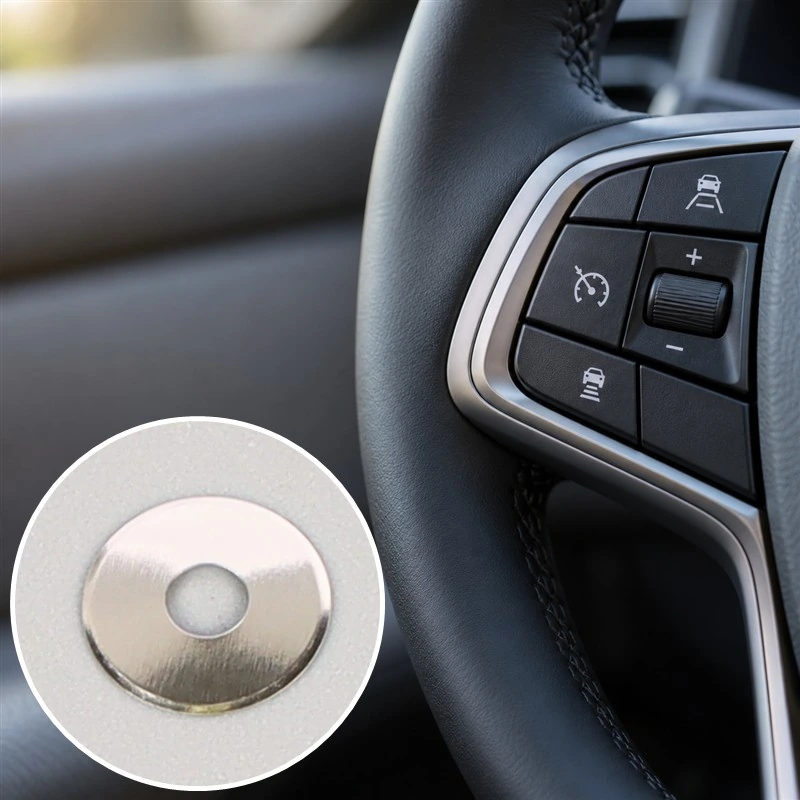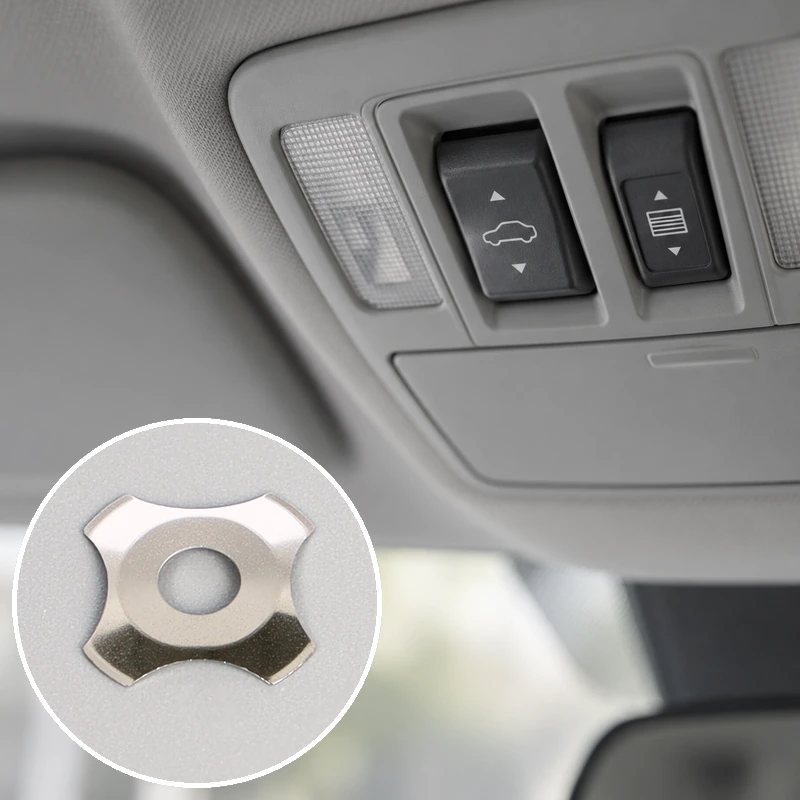
Keypads that must feel crisp and light up at the same time put two competing demands on the same few millimeters of board space. The dome has to sit flat, snap cleanly, and stay centered for its whole life, while the light behind the key has to reach the legend without bleeding into the next one. Engineers who have backlit a tactile key the conventional way, with the light source on the far side of the board, know how much of it is lost on the way through, which is why a four-legs dome switch manufacturer supplies this shape in a spread of diameters and force steps.
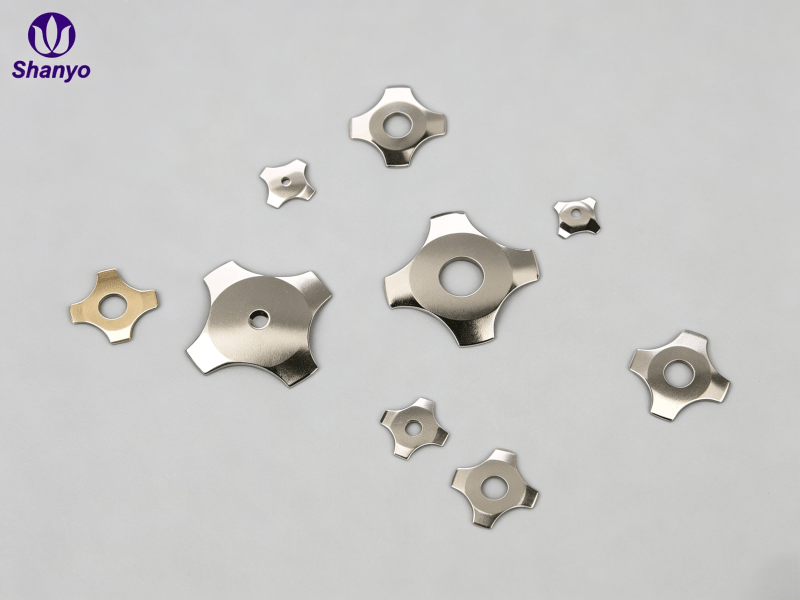
A four-leg metal dome with a center hole is a tactile dome switch whose crown carries four short legs and an open hole at its center. The legs stand the dome on its contact pads and keep it from shifting during assembly, the crown flexes down when pressed to close the circuit, and the center hole lets a light-emitting diode sit beneath the dome so the key can be lit from the front of the board. The hole may also provide a locating feature or air path only where the approved assembly provides the necessary clearance and vent continuity.
This guide covers how the part is built, why the hole exists, how it compares with other shapes, and what to settle before ordering.
What is a four-leg metal dome with a center hole?
It is a normally open, momentary contact stamped from thin spring stainless steel. The crown is the moving contact, the four legs are the fixed supports, and the center hole passes through the crown without carrying current. Pressing the crown through its snap point closes the circuit at the specified inner contact region around the opening; the pad geometry must match the model drawing, and releasing it lets stored elastic energy restore the original profile.
Sometimes called a cross dome, it is one of the four shapes that dominate keypad design alongside round, triangle, and oval. What sets it apart is that its supports are discrete rather than continuous, so instead of an unbroken rim, it stands on four feet, which affects routing, sealing, air flow, and alignment and makes the part taller than most.
How the four legs and the center hole work together
The legs locate the dome, spread the load evenly, and form the outer contacts, which is what keeps the click consistent across a wide panel. They also open the gaps that make same-side routing practical, so positive and negative traces can run on one face of the board beneath the dome, and a single-sided board can carry a complete switch. The center hole carries no current, so its work is purely mechanical and optical.
Materials and plating used on four-leg domes
Spring-grade stainless steel is the standard material, most often SUS301 or SUS304. Strip thickness and heat treatment are chosen with the formed geometry, because force comes from stored bending energy in the crown and the hinge around it rather than from flat thickness alone. Plating goes on the contact side: a natural finish suits dry environments, nickel gives a stable low-resistance contact at a modest cost, and gold is chosen where oxidation resistance matters most.
Loose domes or dome arrays
Four-leg domes reach the line as loose parts in bulk or cartridges, which suits prototypes and moderate volumes, or as arrays pre-positioned on an adhesive carrier so a whole keypad goes down in one movement. Arrays cost more per dome but cut placement time and remove most alignment mistakes.
Why does a four-leg metal dome need a center hole?
The hole is there for light. It lets a light-emitting diode sit underneath the dome, on the same side of the board as the switch contacts, instead of behind the board. Light passes through the hole and straight through the overlay legend, which is brighter and more even than light that has to cross the board substrate first. The hole also serves as a locating feature and a second air path.
Backlighting a keypad from under the dome
Moving the light source under the dome shortens the optical path, so less light is absorbed and less is scattered sideways into neighboring keys. Without a hole the descending crown would land on the diode and press against it on every actuation, which is a direct route to a cracked component and a dead backlight.
Locating pins and mechanical alignment
A pin through the center hole fixes the dome in both board axes, which matters on crowded boards and flexible circuits where a dome that drifts a fraction of a millimeter ends up pressed off-center. Off-center actuation raises the felt force, reduces the tactile drop, and can eventually deform the metal permanently.
Air venting and pressure equalization
A sealed perimeter and a sealed overlay trap a pocket of air underneath, and that air has to move aside when the dome is pressed and return when it is released. With no path, the pocket resists the finger, the dome squashes instead of snapping, and the key feels dead. Four-leg geometry helps, because the gaps between the feet provide vent sectors, and the center hole adds a second route. What the user reads as a click is the snap itself, and standards treat it separately from slow-action contacts: a snap action contact, in the language of IEC 60947-5-1, is one whose contact motion is substantially independent of how slowly or quickly the actuator is moved.
How does it compare with other metal dome shapes?
No single shape wins on every count. Force, life, and tactile response must be compared for specific models under equivalent test conditions. Four-leg gaps can assist routing, and oval outlines can suit long, narrow keys; neither geometry alone establishes sealing or a performance ranking. A center-hole four-leg dome is chosen when backlighting or same-side routing matters more than the smallest footprint.
| Dome shape | Typical size range | Typical force range | Tactile feel | Sealing | Cycle life | Routing under the dome |
| Round | 3 to 20 mm diameter | 100 to 600 gf | Soft to firm | Good, continuous edge | Model-specific qualified life | Awkward |
| Four-leg | 5 to 20 mm | 125 to 500 gf | Crisp and balanced | Assembly sealing required around leg gaps | Very high | Easy, traces run under the legs. |
| Triangle | 5 to 13 mm | Per selected model specification | Crisp, high force | Moderate | High | Moderate |
| Oval | 3 x 4 mm to about 51 x 13.7 mm | 100 to 500 gf | Soft | Moderate | High | Moderate |
These bands reflect published dome series data across the main shape families, checked 12 October 2026, and are orientation rather than a specification for any single part.
Versus round domes
A round dome may suit a circular footprint, but life and sealing must be established for the selected model and finished assembly. Against that, it needs a clear square of board roughly equal to its diameter in both directions.
Versus triangle domes
Triangular domes offer a different support geometry and may include locating feet. Select operating force from model data and ergonomic requirements, not outline alone. Retention and high-temperature suitability depend on the specific dome and assembly.
Versus oval domes
Oval or oblong models can suit long, narrow board regions. Their width, force band, and tactile response must be compared using specific drawings and measured curves; a fixed half-width or softer-feel rule does not apply to every model.
What is the strongest dome shape?
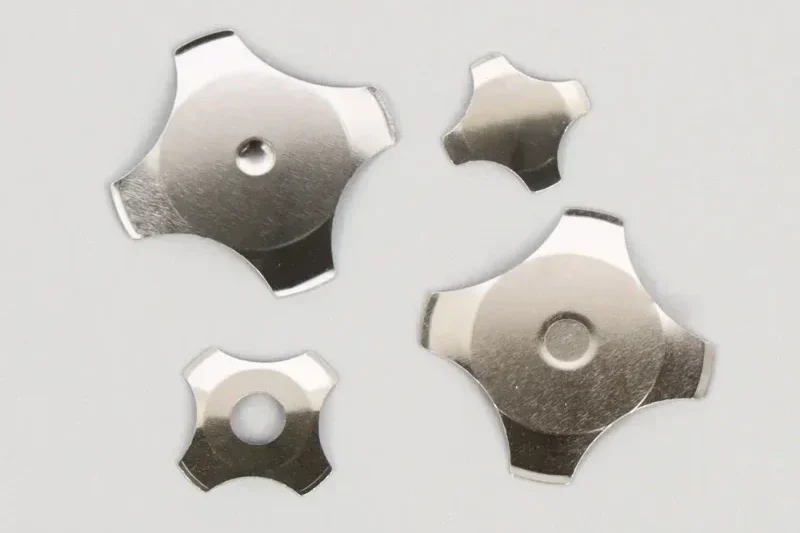
Strength depends on which strength is being measured, and the answers do not agree. No outline universally provides the highest actuation force, best alignment, or longest life. Compare geometry, material, retention, and model qualification data under the same conditions.
Strongest in force
For a high-force key in a small footprint, compare suitable models using their specified operating force, height, travel, and life. A triangular outline alone does not establish a force advantage over round or four-leg designs.
Strongest in stability
Consistent feel requires controlled geometry, actuator alignment, support coplanarity, and retention. Four-leg models require each foot to seat correctly, but four support points alone do not guarantee better alignment or repeatability than other shapes.
Strongest in life
For long service life, compare model-specific qualification reports with equivalent actuator, travel, electrical load, environment, and failure criteria. Round geometry alone does not establish the longest life; finish, venting, and support also matter.
| Metric | Shape that leads | Why |
| Peak actuation force | Model-dependent | Compare measured force curves under equivalent conditions |
| Alignment and repeatability | Assembly-dependent | Control retention, alignment, and support coplanarity. |
| Cycle life | Model-dependent | Compare qualified cycle life and failure criteria |
| Backlit keypad integration | Four-leg with center hole | Light passes through the dome. |
What is the weakest part of a metal dome?
The transition ring is the weakest part. It is the visible band where the curved crown meets the feet, and it works as the hinge that stores the energy needed to push the dome back into shape. Once that ring is dented, flattened, or cracked, the dome loses force and crispness and, in the worst case, stays stuck in the pressed position.
How the transition ring gets damaged
Most damage happens in handling and assembly rather than in service. The usual routes are traveling the dome past the flat plane of its feet, pressing the crown with a sharp object such as a pen tip or fingernail, using a flat actuator wider than the transition ring, and actuating the dome while the feet are not evenly supported.
What damage looks like in the field
The first symptom is a change in feel rather than a failure. Actuation force drops, the tactile ratio falls, and the click turns mushy, which is why the problem often reaches production before anyone notices. In severe cases the dome becomes bistable and does not reliably return. A center-hole dome has a second ring to inspect at the edge of the hole, where the crown is interrupted and the cross-section is thinner.
Actuation force, travel, and life you should expect
Force and life trade against each other. A dome pressed harder and traveled further wears faster, so a design that needs a very firm key normally accepts a shorter service life unless material, plating, and support conditions compensate. For four-leg domes the working range commonly sits between about 125 gf and 500 gf depending on diameter.
Actuation force and travel
Four points on the force curve define how a dome behaves: the initial preload, the peak or trip force reached just before snap-through, the post-snap contact force, and the return force on release. The drop between peak and post-snap force is what the finger reads as a click, and the usual way to express it is the tactile ratio, calculated as the peak-to-post-snap force drop divided by peak force and multiplied by 100, using explicitly defined points on the agreed pressing curve. Return force on the unloading curve is a separate measurement; if the supplier uses different terminology, document its force-point definitions. A higher ratio feels sharper but can cost life. The force a user feels is measured at the assembled interface, not on a bare dome, because an overlay of moderate thickness can add tens of grams.
Cycle life
Use the life rating and qualification conditions for the selected model; mixed series data does not establish a universal life ranking between four-leg, triangular, and round domes. Plating affects wear at the contact interface, venting affects how cleanly the dome returns, and support conditions decide whether the feet are evenly loaded.
PCB layout and assembly notes for a center-hole dome
Lay the board out around the chosen dome rather than adapting the dome to a copied land pattern. The center pad, the pads under the legs, the clearance around the hole, and the air path all have to be designed together, and the actuator has to be centered on the crown. Reusing a land pattern from a different dome series is the most common source of inconsistent feel.
Pad layout and trace routing
For a center-hole dome, the inner contact region must meet the conductive crown around the opening; use the approved model land pattern rather than assuming a solid pad directly beneath the hole. Coordinate electrical clearance with the LED, any locating feature, and the actuator throughout the stroke. Keep vias out of it, because a via inside the pad can wick solder and leave a bump that prevents full snap-through; snap dome layout guidance commonly keeps vias in the region of 1 mm clear of the pad edge. Each leg should land fully on its own pad with no adhesive beneath it.
Placement and packaging
Cartridge packaging pairs with automated placement equipment and, at volume, with a placement pen or an automated dome placement machine, both of which seat the dome without the operator touching the crown. Hand placement works at low volume but invites three mistakes: denting the transition ring, seating a leg off its pad, and skipping the orientation check.
Overlay, actuator, and stack height
The overlay sits above the dome and transmits the pressing force, so its stiffness and thickness belong in the force calculation rather than the afterthought column. The actuator must be centered on the crown and narrower than the transition ring, whether it is a molded nub in a rubber keypad or a feature on a plastic key.
Where four-leg metal domes with a center hole are used
They appear wherever a key has to be lit from behind and still be pressed reliably for years. Remote controls, handheld instruments, industrial control panels, medical devices, automotive switch panels, wearables, and the backlit interfaces used in aviation and defense equipment all rely on the same combination of a clear light path and a crisp click.
The shape turns up across such different products because the constraints repeat. Any device with many keys in a small area faces the same routing problem, and any device used in the dark faces the same light problem. Flexible circuits and membrane switch panels gain the most from same-side routing, because on a flex circuit every via is a potential failure point.

FAQ
Can a four-leg metal dome with a center hole be soldered directly to a board?
Rarely, and not by the dome itself. Stainless steel does not wet readily with solder, and soldering heat can alter the temper of the strip, changing the force curve permanently. Domes are normally held by an adhesive overlay or a dome array or supplied as a surface-mount variant with tabs for reflow soldering.
Does the center hole weaken the snap or shorten the life of the dome?
Less than the geometry suggests. The snap is produced by the transition ring around the crown, not by the material at the very center, so a proportionally sized hole has a modest effect on force and travel. What the hole does change is the cross-section at its own edge.
Can a center-hole dome be sealed to reach an IP rating?
Sealing is a property of the finished panel, not of the dome. Ingress is controlled by the overlay, the panel gasket, and the housing, while the dome only has to allow air movement so it can return after each press. A sealed panel therefore combines a bonded overlay with a dedicated vent path through a breathable membrane.