Consumer products rarely fail at the circuit when a button stops working. They fail at the switch. Metal domes sit under remote keys, controller buttons, smartwatch side keys, and appliance panels, and once the housing is tooled, changing the dome under it is expensive. Sourcing metal domes for consumer electronics works better when you start from the device and work backwards.
Choosing a metal dome for consumer electronics means fixing five things before you ask for samples: actuation force, diameter and height, travel, shape, and plating. The rest of the decision, from dimple to mounting format, follows from those five plus the number of presses the device will see in its life.
This guide follows that order: requirements, then parameters, then validation.
Start with the device, not the dome
The dome is a component; the device is the requirement. Fix the press count, button area, stack height, and environment first, then let them narrow the specification.
| What you already know | What it decides |
|---|---|
| Press count and product life | life cycle target, dimple budget |
| Button area and actuator diameter | dome diameter, force spread |
| Stack height between board and housing | dome height, travel, spacer |
| Dust, spills, cleaning, temperature | sealing, venting, plating |
Diameter and plating both move unit price, so fixing requirements first avoids paying for size or finishing the device that does not use it.
The five parameters that decide your metal dome
Actuation force, diameter and height, travel, dome shape, and plating decide how a button feels and how long it lasts. Change one, and the other four usually need rebalancing.
A custom tactile metal dome is stamped from stainless strip around 0.05 to 0.10 mm thick, formed, and plated to order. Consumer-grade parts are commonly published in these ranges.
| Parameter | Typical consumer range | What it controls |
|---|---|---|
| Actuation force | 100 to 350 gf, often held to about 20 gf | how light or firm the press feels |
| Diameter | 4 to 12 mm | tactile strength, board area |
| Travel | 0.12 to 0.5 mm | quick activation against a longer throw |
| Snap ratio | 30 to 60 percent | a crisp click against a vague press |
| Contact resistance | under 1 ohm with nickel or gold plating | closure stability |
| Life cycle | 500,000 to several million presses | durability at the press rate |
These are starting ranges, not specifications. What counts is the number your assembled stack produces.
Actuation force
Force is where consumer projects go wrong first. Too light, and a sleeve brushing the panel registers a press. Too heavy, and the key feels stiff by the tenth press. Handheld devices sit lower because they are worked by a thumb at an angle. Tolerance matters more than the nominal figure: on a ten-key remote, spread inside a batch, it shows up as keys that feel unlike each other.
Diameter, height, and travel
Smaller domes fit smaller keys and usually last longer, because each press stresses less material. They also travel less, and short travel is harder to feel. Larger domes click harder but need more board area and a taller stack. In a thin housing, height and travel bind the design before diameter does.
Dome shape
Shape decides where the dome touches and where stress goes.
| Shape | Contact behavior | Where it fits |
|---|---|---|
| Round | one contact point at the center | low-profile keys, tight spaces |
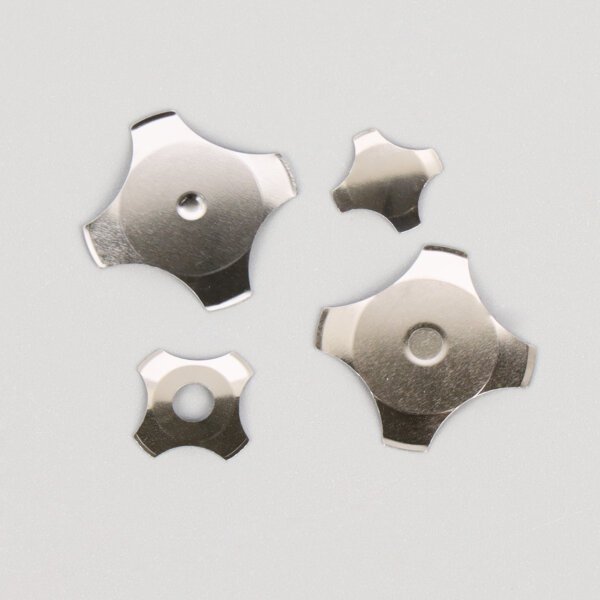
| Four-leg | center dome with four support legs | multi-key panels, most button work |
| Triangle | two feet through a board via | narrow layouts, small handhelds |
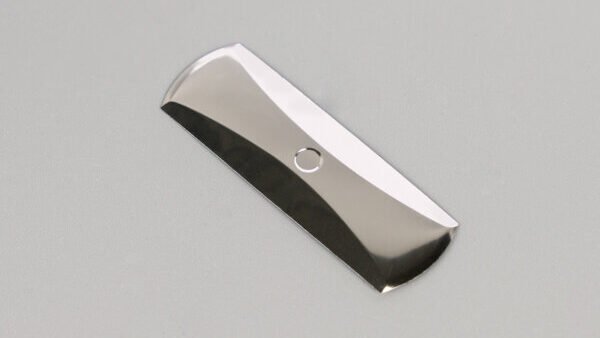
| Oval | one or two actuation points | long, narrow keys |
Shape also has to match the pad layout, so moving from round to four-leg is a board change, not a component swap.
Plating and material
Stainless steel protects itself with a thin, transparent chromium oxide layer. That layer keeps rust away, and it also adds resistance at the contact. Nickel plating slows the oxide; gold stops it and holds contact resistance steady over millions of presses, which is why it costs more. Low-voltage circuits notice a thin oxide film more, so gold earns its price where the signal is small.
Matching dome specifications to common consumer devices
There is no universal consumer specification. Remotes, controllers, wearables, and appliance panels push the same five parameters in different directions, so start from the closest match and adjust.
| Device type | Force | Diameter | Plating |
|---|---|---|---|
| TV and set-top remotes | 150 to 250 gf | 4 to 8 mm | gold on high-use keys |
| Game controllers | 180 to 300 gf | 6 to 10 mm | gold |
| Wearables and earbuds | 160 to 250 gf | 3 to 5 mm | gold or nickel |
| Appliance panels | 200 to 350 gf | 8 to 12 mm | nickel, gold on high-use keys |
| Keyboards and peripherals | 200 to 350 gf | 6 to 12 mm | nickel |
Treat the table as a starting point. A metal dome switch in a remote takes thousands of presses a month from a thumb moving at an angle, so life rating leads. A controller is pressed faster and in bursts, so snap ratio matters as much as life. A wearable key has almost no room, so small diameter and short travel are forced on the design before any preference is expressed.
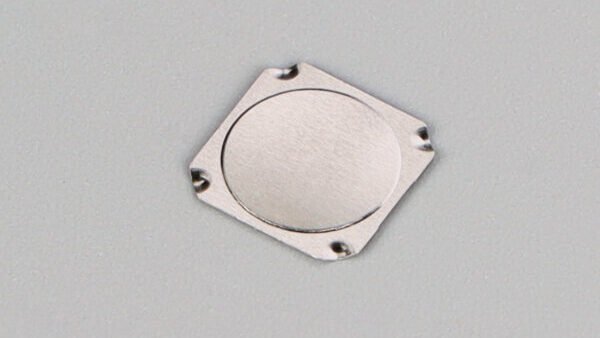
Dimpled or non-dimpled: which one survives a dusty remote?
A dimpled dome holds contact in dusty conditions and in very light designs. A non-dimpled dome generally lasts longer. Choose the dimple when contamination or a feather-light press is the bigger risk.
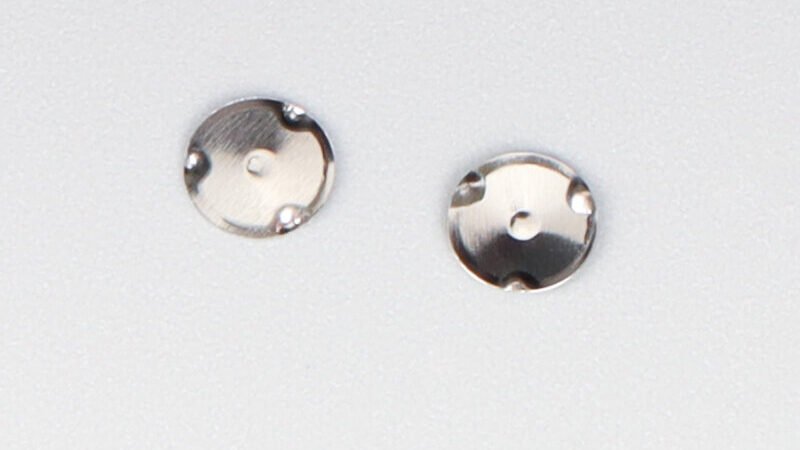
The dimple is a small concave feature at the center of the dome, up to about 0.2 mm deep. It was added to cut the tease effect, where the dome clicks without closing the circuit. Only the dimple meets the pad, so dust settles around the contact rather than on it, and a few presses can clear it.
The cost is mechanical. Forming a dimple puts extra stress into the part and adds a failure point, so life testing usually shows a dimpled dome falling short of a non-dimpled one at the same force. High-cycle keys in a clean, sealed stack are often better off without one.
Mounting format: loose domes, tape and reel, or dome arrays
Loose domes suit prototypes and small runs. Tape and reel suits automated placement. A dome array suits any panel with more than a handful of keys, because spacing and alignment come from the film instead of the operator.
| Format | Best for | Trade-off |
|---|---|---|
| Loose domes | prototypes, small runs, design changes | alignment error, double doming |
| Tape and reel | volume lines with pick-and-place | tooling and feeder setup |
| Dome array or dome sheet | multi-key panels and keypads | an extra film layer and tooling |
An array carries every dome on one adhesive carrier, so a single pass applies the whole keypad. That removes the placement error, which later shows up as a key needing a harder press, and it evens out the feel across a batch. Arrays can also be top vented through the polyester layer, keeping the vent path off the board.
Sealing, venting, and the environment the device lives in
A dome needs air to move in and out as it collapses. Venting, plus a sealed top layer, is what keeps a remote or appliance panel working after crumbs, spills, and a few years of thumb grease.
When the dome snaps down, the air under it has to go somewhere. Without a vent that air compresses, the press stiffens, and the dome may not return cleanly. Suppliers vent in three common ways: channels cut from dome to dome in the spacer layer, top venting through the polyester of a dome sheet, or vent holes routed through the board.
Sealing is the other half of the job. A dome sheet with sealed edges keeps liquid and particles away from the contact pads. Stainless resists corrosion on its own, but the chromium oxide on its surface conducts poorly, so sealing and plating decisions belong together. Assemblies are commonly rated from about -40 to +125 degrees Celsius.
How to validate a dome before mass production
Force and travel have to be measured rather than estimated, and the dome has to be tested inside the real stack. The housing, silicone post, and overlay change the result more than the dome does.
A force-displacement test produces a hysteresis loop, and that loop gives you actuation force, displacement, contact force, return force, and the tactile response slope users actually feel. The method is standardized: ASTM F2592 covers how to measure the force-displacement characteristics of a membrane switch and how to read teasing from the curve.
Testing a dome alone tells you less than most people expect. Overlay stiffness, actuator travel, adhesive clearance, and the finish on the board pad all shift the numbers. Loose domes are fine for early feel tests, but final approval should run on the assembled stack, with life testing at the expected press count plus margin. Watch for teasing, where the dome clicks without making contact; it usually points to a force or conductivity problem rather than a worn-out dome.
What to put on your RFQ
Give the supplier the device, the five parameters, and the volume. A quote based on a dome diameter alone comes back with assumptions you have to renegotiate later.
- Where the key sits and what it does
- Target actuation force, with tolerance
- Diameter, height, and travel budget
- Shape, matched to your pad layout
- Plating and the finish on the board pads
- Dimpled or non-dimpled
- Mounting format, volume, and life target
Send the drawing and the annual volume with that list, and the supplier can answer with a specific part instead of a range of options.
FAQ
Does a longer-life metal dome always cost more?
Not automatically. Life comes from shape, force level, material thickness, and plating more than from a premium grade of steel, and a lower-force four-leg dome in a well-built stack can outlast a higher-force round dome of the same size. Set the life target from real press counts rather than paying for the margin the device never uses.
Can a metal dome switch replace a silicone rubber keypad in an existing housing?
Sometimes, but the stack has to be checked first. A metal dome is thinner than a rubber keypad of the same button height, so the actuator post and spacer thickness usually change, and the board needs a matching pad layout. The gain is force stability, since rubber hardens with age while a dome works inside its elastic range.
How do you tell a good dome batch from a bad one?
Force. Pull a sample and check actuation force and return force against the tolerance rather than judging by eye, because a batch with a wide spread can pass a visual check and still produce keys that feel unlike each other. Debris and half-formed dimples are visible; a soft snap usually is not.