A door switch looks like the cheapest part on the interior bill of materials. One stamped dome, one pad, one plastic key. Then the first pilot build lands and the driver’s window key feels nothing like the signed-off sample, or the ball test on the armrest fails, or the force has drifted 15 percent after a winter outside. None of that comes from a badly made dome. It comes from validating a component instead of the assembly it lives in.
Validate the assembled switch, in a fixed order: freeze the mechanical stack and travel, measure force and tactile ratio on the real keycap at both ends of the temperature range, clear the accidental actuation test in FMVSS 118, prove contact stability after climate exposure, then accept production evidence. A custom metal dome manufacturer can only meet a requirement you can state as a number with a test condition attached, so the specification work belongs to you.
Each gate costs more to reopen than the one before it, which is why the sequence matters as much as the content
Fix the mechanical interface before you compare any dome
The force at the key is what is left after the keycap, the air gap, the overlay and the pad have taken their share, so the interface has to be frozen before any dome is shortlisted. Catalogue values compared across suppliers at this stage will not survive the first build.
A dome rated at 300 gf on a flat platen does not deliver 300 gf through a 12 mm rocker key with 0.6 mm of free travel. Lever ratio, plastic stiffness and trapped air all act on the same press.
The five layers that set the real force
- Keycap or rocker. Length and pivot set the lever ratio.
- Overlay or silicone skin. Adds a spring and, in cold, stiffens before the metal does.
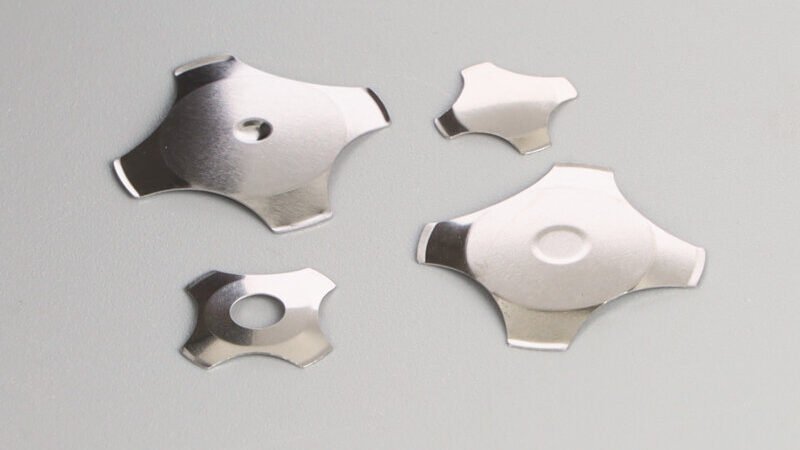
- Metal dome. The only layer with a published force, and the only one the supplier controls.
- Spacer and adhesive. Sets the gap to the pad and travel lost before contact.
- PCB pad and finish. Roughness and plating change resistance and the snap-through point.
Put the stack in the drawing with a tolerance on each layer, then state the force window at the keycap.
Travel and stack tolerance
Total travel for a cabin dome usually falls between 0.2 mm and 0.5 mm, and the panel opening has to leave room for all of it plus the keycap skirt. The failure to design out is bottoming: at maximum material condition, the tallest keycap on the shortest dome must still reach snap-through before it hits the housing. Check the extremes, not nominal, because the warranty complaint is always “it only works if you press the edge”.
Prove the tactile response on the real keycap
Force and tactile ratio have to be measured on the assembled key against a curve, not read from a datasheet. A single force figure hides the two numbers that decide feel: peak force and return force.
Record the full force-displacement curve at a fixed crosshead speed in both directions. The gap between peak and return force is the click the driver reads, quoted as a tactile ratio. A low ratio turns a crisp key mushy even when peak force is on target.
Off-center and angled presses
A window key is not pressed in the middle. The thumb lands near the leading edge, at an angle, often through a glove. Force at 25 percent of the dome radius can sit well above the centre value, and on an oblong dome the long axis is softer. Test centre, the edge the thumb reaches and the worst corner of the opening. If edge force runs high, an oblong or four-leg dome usually beats raising dome force.
Force drift across the temperature band
Cabin parts are commonly specified from −40 °C to +85 °C, and positions in direct sun need a higher class. The metal barely moves across that band; the adhesive and overlay do. Soak the assembly at each temperature and measure before it returns to room temperature. A drift of 10 to 15 percent is normal. If your window is tighter, the dome grade has to change, not the tolerance.
Clear the FMVSS 118 accidental-actuation test
FMVSS 118 does not test the switch electrically. It tests whether a child kneeling on the armrest can close a window, and it is the requirement most often discovered after the bezel tool has been cut.
Paragraph S6(a) of 49 CFR 571.118 applies a stainless sphere of 20 mm radius, at any angle, with a force not exceeding 135 N, to any portion of the actuation device. The window must not begin to close. Paragraph S6(c) requires closing to work by pulling away from the mounting surface, so a switch that closes on a straight push does not comply, however good its feel.
The failure is usually structural. In a 2025 regulatory filing, a vehicle manufacturer reported that a driver’s door switch actuated because the plastic around it flexed enough for the ball to reach the switch at about 130 N, just under the limit. The switch was fine. The bezel was not.
| Design lever | Effect on the ball test | Kostnad |
|---|---|---|
| Recess the key below the bezel | Keeps the sphere off the key | Bezel tooling |
| Guard rib or raised surround | Blocks angled approach | Packaging impact |
| Raise actuation force | Buys margin, costs comfort | Free, limited by feel |
| Reduce exposed key area | Smaller target for the sphere | Keycap redesign |
| Dual or series dome | Needs two snap-throughs | Part cost, stack height |
| Pull-to-close mechanism | Meets S6(c) directly | New mechanism, new validation |
Test the armrest module, not the switch on a fixture. The question covers every plastic part between the ball and the dome.
Validate the contact, not just the click
A dome that clicks is not a dome that switches. Contact resistance, bounce and the current the contact actually sees decide whether the window module reads a press at all.
Measure resistance with a four-wire Kelvin setup at a defined test current, not a hand-held meter, and set the acceptance limit before the first sample arrives. Then watch bounce. A key that chatters sends a double pulse to the module input, which on weak debouncing reads as a stuck key.
Plating choice by position
| Plating | Resistance | Corrosion | Where it fits |
|---|---|---|---|
| Nickel | Adequate for signal loads | Oxidises in damp heat | Dry, frequently used keys |
| Silver | Lowest of the three | Sulfidation in polluted air | High-current or relay-driving keys |
| Gold over nickel | Low and stable | Best against damp heat and sulfide | Door and pillar keys, low-current inputs |
Gold costs more and holds its resistance through damp heat and sulfide exposure, which is why door and pillar keys at microamp module inputs use it.
Resistance after environmental exposure
The number to hold is the resistance after the chamber, not the fresh one. Set acceptance first: force within plus or minus 20 percent of initial, resistance no more than twice the initial figure, insulation resistance at least 10 MΩ, no adhesive delamination. Nickel-plated parts come back with rising resistance after damp heat. Gold over nickel usually does not.
Run life and environmental tests under door conditions
A life rating is only transferable if the test conditions match the door. Published figures of one million to five million actuations assume centre actuation at room temperature, and a door is neither.
A window key pressed 15 times a day for 15 years is about 82,000 presses, so a one million rating leaves an order of magnitude of margin. The rating is rarely the constraint. What matters is whether the dome still feels the same at press 80,000.
Life test conditions that mirror the door
Four variables belong in the requirement, because a supplier cannot guess them:
- Temperature at which the test runs, or a cycle that includes the extremes.
- Contact point: centre, or the off-centre point the keycap loads.
- Rate and dwell, since a fast press loads the dome differently from a slow one.
- The load being switched, because electrical duty affects contact erosion.
Ask for the conditions, not just the cycle count. Five million cycles at 23 °C with a centred press says little about a door in Phoenix.
Climate, corrosion and vibration
Thermal shock from −40 °C to +85 °C over 100 to 500 cycles catches adhesive softening and force drift. Damp heat at 85 °C and 85 percent relative humidity for 240 to 1,000 hours catches plating and adhesive hydrolysis. Salt fog per ISO 9227 matters for exterior positions; inside a door card, condensation governs. Vibration follows ISO 16750-3, which sets severity by mounting location, and the run needs an event detector so chatter registers as a failure.
Sealing for a door-mounted switch
The dome has no IP rating of its own; the module does. A door key sees spillage, cleaning agents and condensation, so sealing belongs in the same review as the force window. Fully sealing traps air under the overlay, and that air changes feel with temperature and altitude. A vent with a pressure-equalising membrane keeps force stable and water out. Settle this before the overlay tool exists.
Close the loop with production evidence
Samples that pass prove the design. Only process evidence proves the parts you receive in month eighteen. Sample qualification and production qualification are separate gates.
The baseline is IATF 16949 for the manufacturing site, which Shanyo has passed, plus a PPAP submission at the level your programme requires. Beyond the certificate, ask for the control plan, the force inspection method with sample size and frequency, and the Cpk on actuation force across the last three lots. A supplier holding force deviation under 5 percent on full inspection is telling you something a certificate cannot.
Traceability matters more than it sounds. The coil lot sets force and the plating lot sets resistance, so a report that cannot link a shipment to both is not traceable in any useful sense. Packaging belongs in the same conversation: pocket orientation on tape and reel, ESD-safe carrier, adhesive shelf life. On the line, a dome array fixes pitch and removes placement error at the cost of a carrier and one part number per keypad, while loose domes need placement tooling and a poka-yoke check.
Shanyo also documents a Valeo dome programme case study that runs from the first RFQ through supplier pre-audit, a fair model of what a tier-one buyer asks before the first order.
A validation gate list for your RFQ
Attach the gates to the enquiry. A supplier who receives test conditions, pass criteria and evidence requests in one document will quote against them instead of against an assumption.
| Gate | What to validate | Condition | Pass criterion | Evidence |
|---|---|---|---|---|
| 1 | Stack and travel at both extremes | Min and max keycap, dome, spacer | Snap-through before bottoming | Stack drawing |
| 2 | Force and tactile ratio on the keycap | Centre, edge, worst corner; −40, 23, +85 °C | Inside the window at all three | Force curves |
| 3 | Accidental actuation | 20 mm sphere, 135 N, any angle, on the module | No closing movement | Assembly test report |
| 4 | Contact integrity | Four-wire resistance, bounce count | Limit met fresh and after climate | Resistance data |
| 5 | Life | Door-representative temperature, off-centre press | No chatter, force inside 20 percent | Life report |
| 6 | Climate and vibration | Thermal shock, 85/85, ISO 16750-3 | Resistance and force inside limits | Chamber reports |
| 7 | Production | Three consecutive lots | Force Cpk target met | PPAP, control plan |
VANLIGA FRÅGOR
How many samples does design validation need before tooling release?
There is no fixed number, but three lots with ten pieces each for dimensional and force checks is common practice, with fewer pieces for destructive tests. Three lots show lot-to-lot spread before you commit tooling, since one build can hide a plating variation that appears in the second run.
Should I validate the dome alone or the whole switch module?
Both, for different reasons. The module is the only valid subject for FMVSS 118 and for feel, because the bezel and keycap change the result. The dome alone suits incoming inspection, where you need a fast force check without building a module.
What has to be re-run if the switch moves to another position in the car?
Re-measure the force window and the ball test whenever bezel or keycap geometry changes, since both depend on the plastic around the key. Re-run the vibration class when the mounting location changes, because ISO 16750-3 sets severity by position. Add a sealing review for any move to a door, pillar or overhead position.