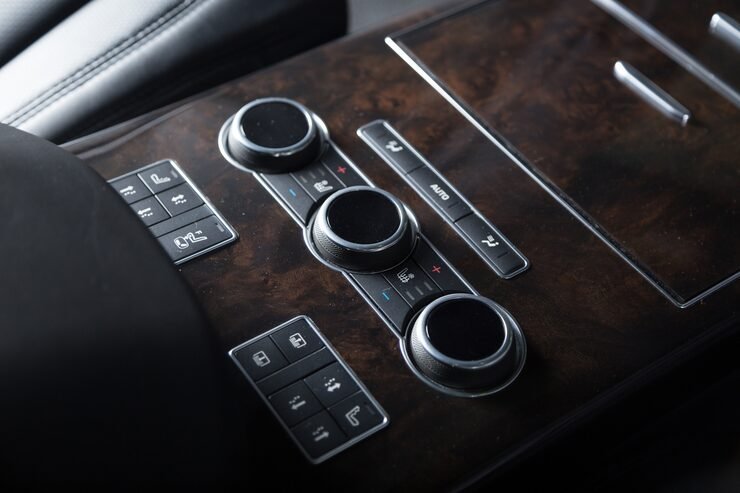
A car cabin still runs on physical presses. Steering wheel pods, climate panels, door modules, and key fobs use a thin stamped disc that snaps under a finger and closes a circuit below. The custom tactile metal dome in each button decides how the press feels, how long the button lasts, and whether the input registers.
Size, force and shape are chosen in that order, and each follows from where the button sits, not from a catalogue page. The key footprint sets the diameter, the pressure a driver should apply sets the force, and the travel and sharpness of the snap set the shape. Automotive electronics tightens all three, because the feel must hold across the cabin range and stay within a narrow force window for the life of the vehicle.
The three parameters are taken in turn below.
What a metal dome does in an automotive control
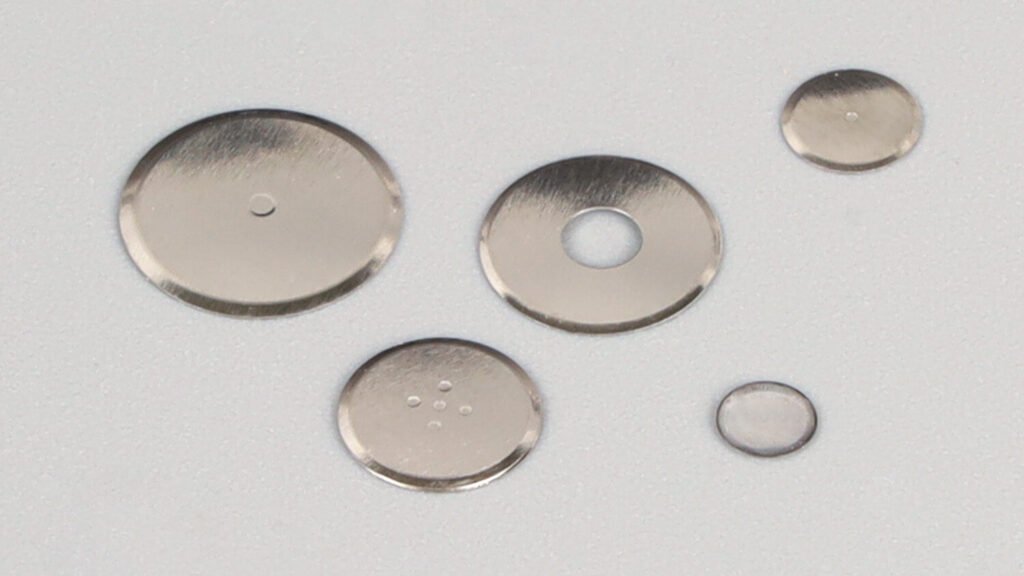
A metal dome is both a spring and a switch. It sits convex over a circuit pad and holds the circuit open; a press collapses it until the center touches the pad, and release springs the metal back.
A driver who has to look down at a hazard switch has lost a second of attention, while a dome returns the press to the fingertip as a snap that survives gloves, cleaning wipes, and years of temperature cycling.
Where the domes sit in a vehicle cabin
The sizes and forces below are a first build for each location, not a final answer.
| Control location | Diameter | Starting force | Motivering |
|---|---|---|---|
| Cluster stalks and small knobs | 3 to 5 mm | 100 to 180 gf | tight footprint |
| Steering wheel pods | 5 to 8 mm | 250 to 300 gf | resists a brush while driving |
| Console and infotainment | 6 to 10 mm | 100 to 150 gf | pressed often |
| Climate and HVAC panels | 8 to 12 mm | 160 to 220 gf | gloved hand |
| Door, window, and seat switches | 8.4 to 14 mm | 230 to 300 gf | deliberate press |
| Key fob and entry pads | 4 to 6 mm | 180 to 250 gf | resists pocket pressure |
A panel with several controls needs a force plan, not one value repeated.
Size options: diameter, travel, and array pitch
Automotive domes run from about 3 mm to 14 mm across. Take the diameter from the key footprint and the gap between keys, then check that travel fits the panel stack. A larger dome tolerates an off-center press and travels further, but it takes up more board area and leaves room for fewer keys.
Common diameters and where they fit
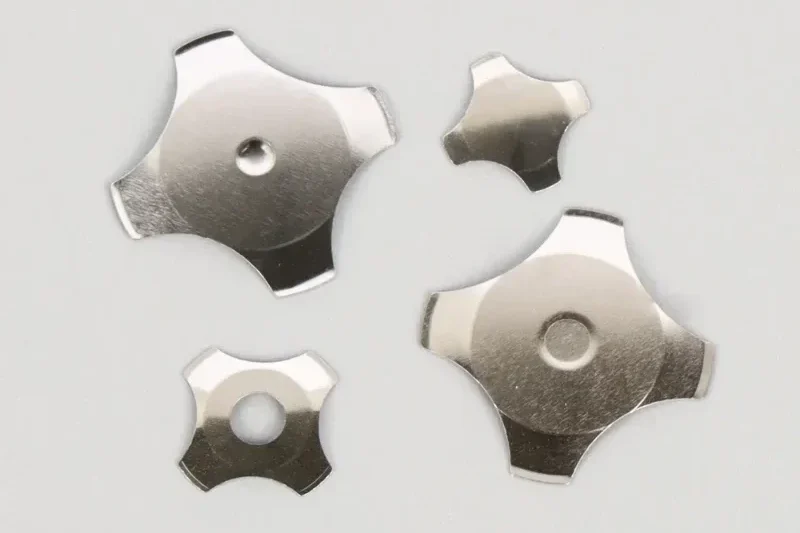
Round domes come at 3, 4, 5, 6, 8, 10, and 12 mm; four-leg domes at 5, 6, 7, 8.4, 12.2, and 14 mm; and oblong domes at 3.5 x 2.9 mm, 4.0 x 2.5 mm, 5.0 x 3.7 mm, and 8.9 x 7.1 mm. The dome sits narrower than the keycap opening and wider than the pads below, so the center meets the pad on every press.
Travel, height, and stack height
Travel varies more by shape than by diameter. Round domes run 0.1 to 0.15 mm, and four-leg domes 0.1 to 0.3 mm, while sealed dome sheet builds are specified from 0.05 mm to 0.5 mm of stroke. The dome, carrier, spacer, and overlay then have to fit under the panel surface without pre-loading the dome, or the circuit holds closed on the line.
Array pitch and alignment
Multi-key panels arrive as dome arrays on an adhesive carrier that holds a fixed pitch through assembly. Arrays solve registration, but not a rigid keycap sitting 0.2 mm off center, and off-center presses raise the force needed. Trapped air turns the press soft the same way.
Force options: matching grams to the control and the driver
Most cabin controls sit between 100 gf and 300 gf. Light buttons suit the functions a driver touches constantly, firmer ones suit functions where a stray press is a problem, and force has to hold steady across a panel.
Force bands by control location
| Manövreringskraft | Känsla | Typisk användning |
|---|---|---|
| 100 to 180 gf | light press | infotainment, small keys |
| 180 to 280 gf | balanced | steering wheel, HVAC |
| 280 to 400 gf | firm press | window switches, console |
| 400 gf and above | strong press | seat controls, large keys |
The same dome feels different in two vehicles because the keycap shares the load: a long plastic key softens the press through leverage, while a short rigid key passes force straight to the fingertip. Judge force with the full stack in place.
The force versus cycle life trade-off
Raising force at a fixed geometry tends to shorten service life. Published dome ratings start at 1,000,000 actuations and reach 5,000,000 on higher-tier builds, and the figure falls as force rises. A button needing a firm press and a long life usually takes a wider dome, more legs to share load, or a stacked construction.
Tactile ratio and click feel
Tactile ratio is peak force minus release force as a share of peak force, or (Fmax – Fmin) / Fmax x 100. A higher ratio gives a sharper break. Published oblong domes run a click ratio of about 40 percent, and automotive panels usually want a clear break so the driver confirms the press by feel.
Shape options: round, oval, four-leg, triangle and square
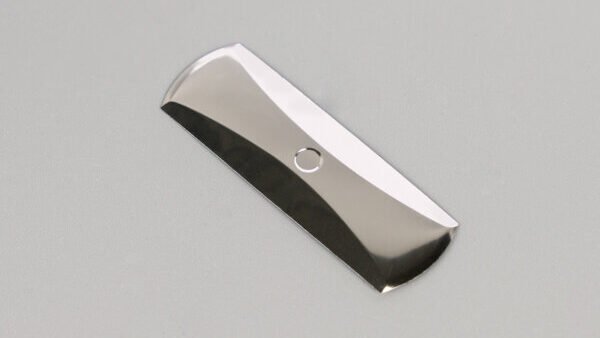
Four-leg domes are the default for automotive panels. They vent air well, hold position in an array, and reach high forces without growing large. Round domes seal best, oval domes fit narrow keys, triangle domes reach high force in a small footprint, and square domes spread load across a wide key.
| Form | Strength | Automotive fit | Watch out for |
|---|---|---|---|
| Fyrbent | high force, strong venting | console, door panels | needs space for the legs |
| Round | continuous edge, easy to seal | climate panels | traps air unless vented |
| Oval and oblong | fits narrow keys | slim bezels, rockers | differs along the long axis |
| Triangle | crisp snap, high force | safety keys | orientation at assembly |
| Fyrkant | even force on wide keys | large single keys | corner presses differ |
Four-leg and round domes
The gaps between four legs let air out and stop the dome sliding sideways in an array while letting circuit traces run underneath. A round dome seals well because its rim is continuous, but that rim also traps air, so without a vent channel the press fights air pressure.
Oval, triangle, and square domes
Oval and oblong domes suit the long, thin keys on slim control bars. A triangle dome reaches higher force in a smaller footprint with a sharper break, at the cost of a narrower sweet spot and a fixed orientation at assembly. Square domes spread pressure across a wide key, so a corner press stays close to the center.
Center dimples and venting
A centre dimple concentrates the finger’s force at one point, shortening travel and sharpening the break without changing the force rating, while a centre hole helps with tooling and alignment. Test both against the plain dome, because the feel changes more than the drawing suggests.
What automotive qualification adds to the specification?
Cabin parts have to hold their force window across temperature, vibration and thermal cycling, and the supplier has to show that with test data rather than a single datasheet figure: a declared temperature range, mechanical testing matched to the mounting location, and lot-level force inspection.
Cabin components are commonly specified from -40 °C to +85 °C, and positions in direct sunlight or near a heat source need a higher class, with automotive dome sheet assemblies published up to +105 °C. Cold is harder to feel because the adhesive and overlay stiffen before the metal does.
Mechanical testing follows the mounting location rather than the part. ISO 16750-3:2023 sets out the mechanical loads and test requirements for electrical and electronic equipment in road vehicles according to where the component is fitted, which is the reference to quote when a button sits on a vibrating steering column.
Supplier evidence counts as much as the specification. Automotive programmes ask for IATF 16949 quality management, stress test qualification in the style of AEC-Q200, and PPAP documentation, with full force inspection holding deviation under 5 percent.
A specification checklist for your RFQ
A usable enquiry states the force and its tolerance, the diameter, the leg count, the travel, the plating, the cycle-life target, the temperature range, and the layout. Anything left out comes back as an assumption, and an assumption on force costs a build cycle.
| Item to specify | Unit | Why the supplier needs it |
|---|---|---|
| Actuation force and tolerance | gf, percent | sets the press and the life trade-off |
| Diameter and leg count | mm, number | fixes tooling and array pitch |
| Resa | mm | checks the panel stack height |
| Plating | gold, silver, nickel | Gold holds low contact resistance. |
| Cycle-life target | actuations | follows button use frequency |
| Temperature range | °C | picks up materials and adhesive |
| Key layout and force map | drawing | keeps adjacent keys even |
Press force and travel at the real keycap, and again at the end of the life test, before release.
VANLIGA FRÅGOR
What force should a steering wheel button use?
Most steering wheel pods land between 250 gf and 300 gf, at the firm end of the cabin range, because the press has to survive an accidental brush while the wheel turns. Drivers work these by feel, so tactile ratio counts as much as force.
Do gloved drivers need a different dome shape?
Gloves absorb part of the press, so a dome that feels crisp with a bare finger can feel vague through leather. A larger diameter at the same force helps, since the load spreads wider, and an oval dome suits elongated door keys.
How many cycles should an automotive dome be rated for?
Published ratings start at 1,000,000 actuations and reach 5,000,000 on higher-tier builds. Match the number to how often the button is pressed: volume and track keys sit highest, hazard and mode keys far lower. In service, failures come more often from contamination or overload than from the metal itself.