
Open up a component catalog for tactile switches, and it can be a bit overwhelming. You see pages and pages of essentially the same silver disc, just with slightly different numbers next to them. 4mm, 5mm, 12mm. 180g, 280g, 400g. It feels like you need a degree in materials science just to pick a button for a garage door opener. But selecting the right round metal dome isn’t just about picking a size that fits on the circuit board. It’s about “the feel.”
The relationship between the diameter of the dome and the force required to collapse it creates the user experience. Get it wrong, and your device feels cheap, or worse, hard to use. It is a balancing act. You are trading off tactile feedback against life cycle, and physical space against actuation force. It’s rarely a straightforward choice.
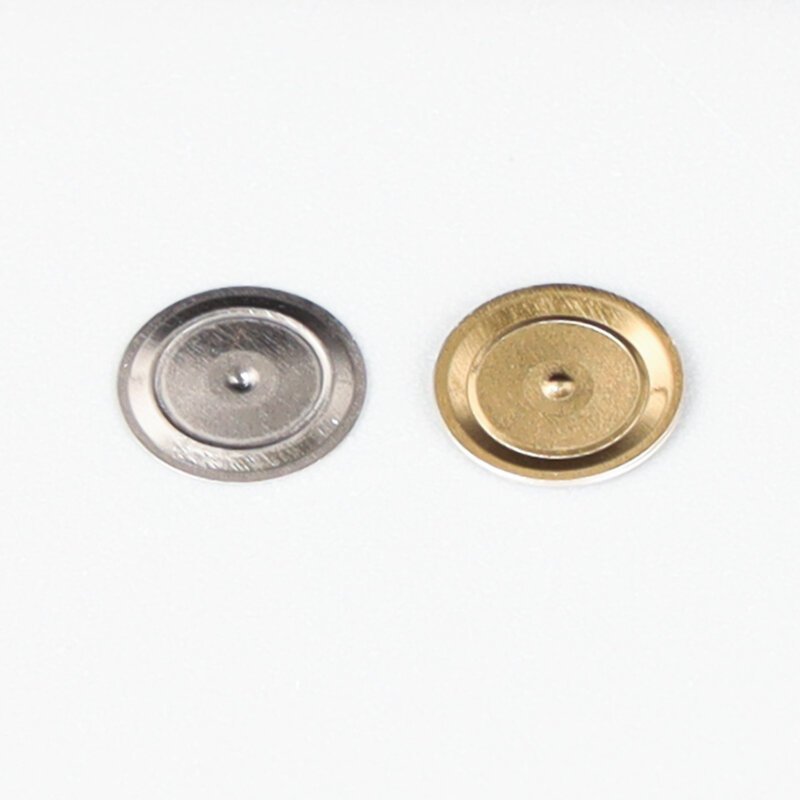
Why Diameter Dictates the Character of a Round Metal Dome
Size matters, but maybe not for the reason you think. Obviously, the diameter has to fit within your PCB layout constraints. If you only have 5mm of space between components, you can’t use a 6mm dome. That’s simple geometry. But beyond the footprint, the diameter dictates the “travel” of the switch.
A larger round metal dome generally has a deeper stroke. When you press a 12mm dome, the center physically moves down further before it snaps than a 4mm dome does. This travel distance changes the perception of the click.
- Small Domes (3mm – 6mm): These tend to have a very short, sharp click. It’s a high-frequency feel, almost like a mouse click. They feel precise but stiff.
- Large Domes (10mm – 20mm): These feel softer and deeper. The snap is more of a “thud” than a “tick.”
When you try to force a small diameter dome to have a long travel, you run into trouble. The metal can only bend so much before it yields permanently. Conversely, a huge dome with zero travel feels like pushing on a wall; you aren’t sure if you actually pressed it.
Understanding Force Loads in Round Metal Dome Specs
Then comes the force, usually measured in grams (gf) or Newtons (N). This is how hard you have to push to get the dome to collapse.
A common mistake is assuming that “more force equals better quality.” That is not really true. A high-force round metal dome—say, 500g—feels very solid, yes. But have you ever tried to type a text message on a keypad with 500g buttons? Your thumb would cramp up in a minute. High force is good for single-action emergency buttons or industrial controls where you need to prevent accidental presses. For consumer electronics, you usually want something lighter, in the 200g to 300g range.
The Importance of the Snap Ratio
The raw number (e.g., 250g) doesn’t tell the whole story. You need to look at the “snap ratio” or “tactile ratio.” This is calculated using the peak force and the return force.
- If the ratio is too low (< 30%), the switch feels mushy. It’s hard to tell when it has actually actuated.
- If the ratio is too high (> 60%), the switch feels very crisp but can be loud and might have a shorter life span because the metal is snapping so violently.
Matching Force to Diameter in Round Metal Dome Design
Here is where the physics gets annoying. You cannot just mix and match any diameter with any force. There are physical limits to the stainless steel material.
If you try to design a tiny 4mm round metal dome with a massive 600g force, the metal is under too much stress. It will likely crack after a few thousand cycles, or it will be so stiff that the “snap” disappears entirely and it just acts like a rigid washer. On the flip side, a large 16mm dome with a tiny 100g force is incredibly unstable. A slight vibration or a drop could trigger it accidentally. It’s too floppy.
Generally, as the diameter increases, the dome can support a wider range of forces, but the sweet spot moves.
- Small diameters prefer higher relative stiffness to maintain a snap.
- Large diameters allow for a softer, easier actuation.
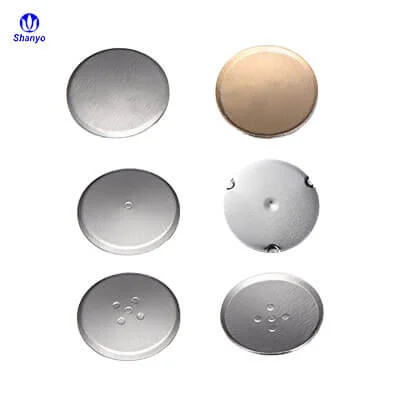
Comparison of Common Sizes and Characteristics
| Diameter Range | Typical Force Range | Travel Distance | Tactile Feel | Best Application |
|---|---|---|---|---|
| 4mm – 5mm | 160g – 250g | 0.15mm – 0.20mm | Sharp, clicky, short. | Wearables, Hearing aids. |
| 6mm – 8mm | 200g – 350g | 0.25mm – 0.40mm | Balanced, crisp. | Mobile phones, Key fobs. |
| 10mm – 12mm | 250g – 450g | 0.40mm – 0.60mm | Softer snap, deeper. | Household appliances, Toys. |
| 16mm+ | 300g – 600g+ | 0.60mm – 0.90mm | Heavy, distinct thud. | Industrial controls, Heavy machinery. |
User Experience and Actuator Selection
The round metal dome is only half the equation. What is pushing it? The actuator (the nub on the back of the overlay) changes the perceived force.
If you use a sharp, pointed actuator, it concentrates the force right in the center. This makes the dome feel lighter than it is. If you use a flat, wide actuator, it distributes the force toward the edges. This makes the dome feel much harder to press. It can actually increase the effective actuation force by 20% or 30%.
It’s frustrating when you spec a 300g dome, but because the actuator is poorly designed, the button feels like it needs 500g to work. This is a common failure in prototyping. You blame the dome manufacturer, but really, it’s the geometry of the button cap.
The Dimple Debate
Should you choose a dome with a center dimple?
- With Dimple: Reduces the need for a perfect actuator. The dimple acts as a built-in force concentrator. It usually provides a better tactile feel if your alignment isn’t perfect.
- No Dimple: Requires a very precise actuator on the overlay to hit the “sweet spot” dead center.
If you want to know more about round metal dome, please read Round Metal Domes: Key Benefits and Common Uses.
Resource
- Hooke’s Law – Wikipedia: While domes are non-linear springs, understanding basic elasticity helps explain the force-displacement curve.
- ASTM F2592 – Standard Test Method: This details how to measure force-displacement in membrane switches. It’s the industry standard for verifying if a dome meets its specs.
FAQ
Can I use a round metal dome on a flexible membrane switch?
Yes, absolutely. In fact, round domes are excellent for flex circuits because their footprint is compact. However, you must ensure there is a rigid backer plate behind the flex circuit. If the surface underneath gives way, the dome won’t snap; the whole assembly just bends.
How does the life cycle change with higher force?
Generally, higher force reduces the life cycle. A standard 250g round metal dome might last 1 million cycles. A high-force 500g version of the same size might only be rated for 300,000 cycles because the steel is being bent more aggressively each time.
Why does my dome sound different after mounting it?
The acoustic “click” is amplified by the PCB and the enclosure. It acts like a drum. If you mount the dome on a thick, rigid board, the sound is sharper. If you mount it on a thin flex circuit inside a plastic case, the sound might be hollow or muted. The dome is the same, but the acoustics of the box change everything.