A tailgate button is one of the few controls a driver operates with a wet hand, a gloved hand, or a thumb through a winter coat. The metal dome inside sits behind a rubber boot, under a garnish, on the outside of the car. Most programs pick a snap dome early, because it looks like the least risky item on the bill of materials, and freeze the drawing before anyone presses the finished button in the cold. A custom metal dome manufacturer that builds these parts for exterior body panels usually asks for the stack drawing before quoting, and that is the right instinct.
Validate three things before the drawing is frozen: that the force reaching the dome still works through the boot, the glove and the cold; that the circuit still reads a clean signal at the press count the vehicle life implies; and that the assembled button survives the loads of its location, which on a tailgate means ice, wash water, road salt and the slam of the gate. Component data covers none of these, and each one fails differently.
The sections below follow the order a program meets these questions, from the parameters to fix first to the evidence a supplier should hand over.
What does validation actually have to prove on a tailgate switch?
It has to prove the button still works when conditions are wrong: cold enough that the rubber has stiffened, wet enough that water sits against the seal, and late enough in life that the plating has seen several hundred thousand presses. A force curve from a loose dome on a bench proves none of that.
Measure the same button cold, after a soak and after the durability run, and the three numbers will not match. The gap is the margin you actually have.
Force reaching the dome through a boot and a glove
Every layer between the thumb and the dome takes force. The boot’s rubber, friction in the seal, any preload in the stack and the stiffness of a wide paddle all add up before the tactile snap switch sees anything. Rubber stiffens as temperature drops, so a button that feels crisp at twenty degrees can feel dead at minus ten and may not snap at all at minus thirty. Test it with a gloved hand at the cold limit, on the finished part.
A signal the module still reads at end of life
A tailgate switch usually carries a low current to a body control module, so the contact interface is the weak point. Resistance climbs as the plating and mating pad oxidise, and the module stops recognising a press. Or a film of moisture bridges the gap and the circuit reads closed when nobody touched it, which on a power liftgate looks like a phantom command.
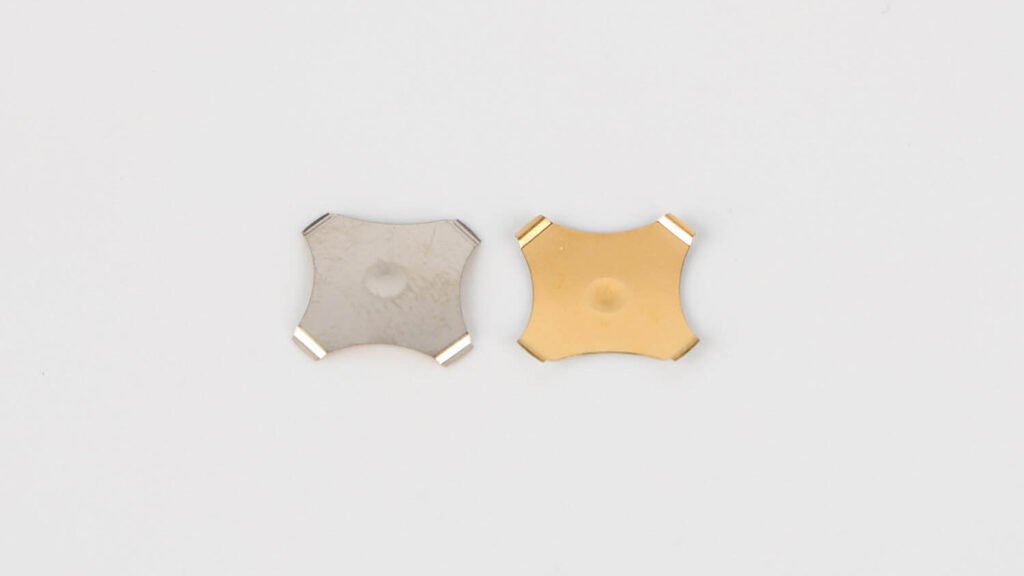
Gold plating is the usual answer where the signal is small, because it does not build a resistive film the way a bare surface does. The drawing needs initial and post-life resistance limits, plus the current, voltage and force at which they were measured.
Which dome parameters should you freeze before building samples?
Fix the force curve, not one force value. The drawing should state actuation force with a tolerance, a minimum return force, usable travel with a reference plane, and a minimum click ratio, then the plating and the pad finish it will sit on. A nominal number with no test method gets argued about after tooling is cut.
| パラメータ | What the drawing must state | How it is verified |
|---|---|---|
| 作動力 | Nominal, tolerance band, probe tip diameter | Force test on the agreed fixture and rate |
| 反作用力 | Minimum after snap-through | Release branch of the curve, not the peak |
| 旅行 | Value plus reference plane | Measured against the support face |
| クリック率 | Minimum ratio | Calculated from the recorded curve |
| メッキ | Thickness on the contact side, plus pad finish | Cross-section, then resistance after conditioning |
| 接触抵抗 | Initial and post-life limits, with conditions | Four-wire measurement at stated force and current |
Actuation force, travel and the total budget
Trip force is one line in a longer sum. Start from what the application can deliver, subtract the boot, the seal and any preload, then specify the dome against what is left. On a tailgate that budget is tighter than on an interior button, because the actuator is a soft rubber surface rather than a rigid keycap. Preload leaves the crown partly collapsed at rest, and over-travel passes its snap point, so both ends need a stop.
Return force, and why a tailgate button sticks
A dome can hit its trip force on the way down and still return too weakly to push the button back out. When the return path depends on rubber rather than on the dome itself, cold weather makes it worse: the rubber stiffens, the dome’s return force is small, and the button stays down. That is the mechanism behind most sticking liftgate buttons in freezing weather, and it is a margin problem rather than a wear problem.
Set a minimum return force, measure it on the release branch, and check it cold. If the stack relies on the boot to push the button back, the boot’s cold stiffness is a design input.
How do you validate the dome inside the real button stack?
Build the stack you intend to ship and measure through it. The actuator, the boot, the carrier, the adhesive and the vent all change the number the customer feels, and none of them appear on the dome drawing.
That means a production-representative housing, the intended boot, the intended circuit and the mounting angle.
Actuator contact and off-centre presses
The force path should reach the crown near its centre and stay there through the stroke. A wide paddle pressed at one edge tilts the load, and a tilted load collapses the metal dome structure unevenly or misses the centre contact. Test centre, edge and corner presses on the finished tactile dome switch, and record whether the dome returns fully.
Venting, drain paths and stack-up
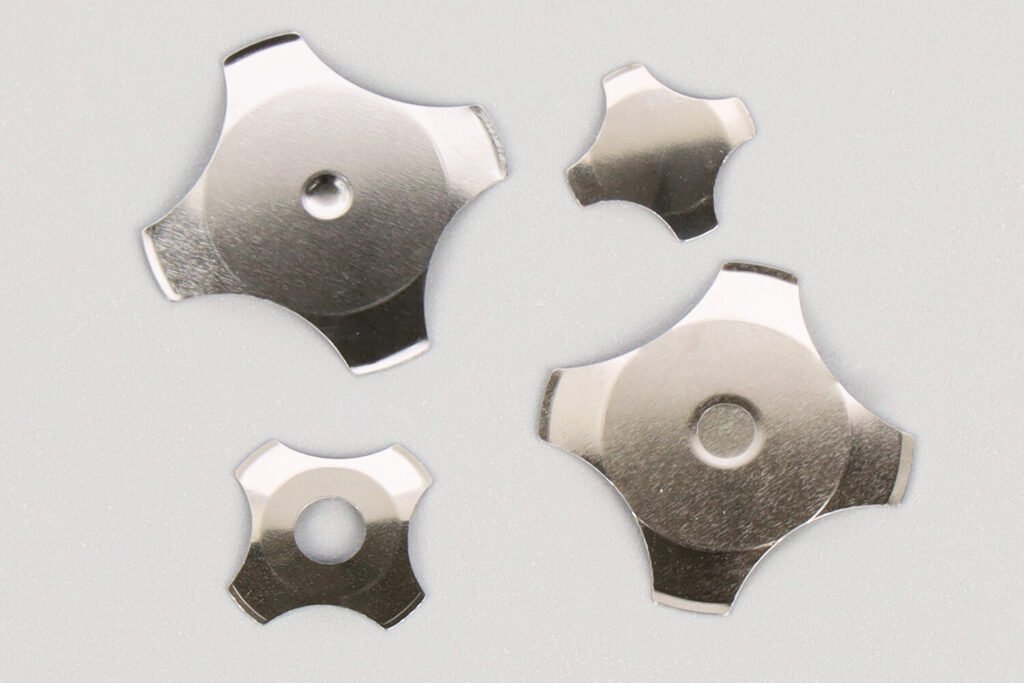
Air has to leave and re-enter the cavity on every press, or the return slows and the button reads soft. A channel through a spacer, or the open space between the legs of a four-leg dome, gives it a path. On a tailgate the vent must not become a water route, and the drain outside the seal has to keep water from standing against the boot.
Tolerances finish the job. Dome height, adhesive thickness, carrier flatness, housing depth and boot compression all add or subtract from free travel. Run the stack at both extremes rather than at nominal, and check that the dome still snaps at the tight end.
What changes when the switch sits outside the vehicle?
The load set changes, and so does the order of the tests. An exterior tailgate switch meets water under pressure, water that freezes in place, road salt and the shock of the gate closing. ISO 16750-4 sets out the climatic stresses for a given mounting location, which is the right starting point: the specification follows the location, not the part number.
Pass or fail at the end of a sequence is weak evidence on its own. The measurement that counts is the one taken after the part has sat, warmed up and been operated again.
Freeze-thaw and the ice lock
Water enters the gaps around a button and freezes there. The moving parts lock, the press never reaches the dome, and the failure looks electrical while the cause is mechanical. The design answer is a force path clear of the places water can reach, usually a rubber element at the centre that still deforms when the perimeter is frozen. The validation answer is a freeze-thaw cycle with water in the gaps, then operation at the cold limit with the actuation force recorded.
Wash pressure, salt and the slam of the gate
A tailgate switch sits in the path of a pressure washer, and a high-pressure hot-water jet is a different test from immersion. Salt spray followed by a function check shows whether the plating and the seal survived, and it should run on the assembled button rather than on a bare dome.
Closing the gate sends a shock through the panel, and the switch body, carrier and solder joints all see it. The harness is the other half: it flexes every time the gate moves, and a conductor that work-hardens at the hinge produces an intermittent command that gets reported as a switch fault.
Why design validation is not production validation
Design validation asks whether the design can meet its requirements while the drawing can still change. Production validation asks whether the production tooling reproduces that design at the quoted rate. A clean set of engineering samples answers the first question and says nothing about the second.
DV on engineering samples
Design validation uses samples built to the intended design with the intended materials. Its job is the edges: worst-case tolerance combinations, the cold limit, the high end of the press count. Record the curve before and after each exposure so drift is visible rather than inferred.
PV on production tooling at the quoted rate
Production validation uses the tooling, fixtures, process parameters and rate that will make the shipped part, and asks whether the process holds the band. Force distribution across a run matters more than the value of any single part, and the plating line counts as part of the process rather than an upstream detail. A change in material, plating, adhesive, tooling or site reopens the question.
What should you check on first-off parts and on the process behind them?
Check the force curve and the contact resistance on the parts, including how the test fixture loads the dome, then check the system that made them. A first-off part that meets the drawing but comes off an uncontrolled plating line is a sample, not evidence.
Documentation, and the Valeo sequence
For an automotive part the paperwork is part of the product: IATF 16949 certification for the site that actually makes the dome, a production part approval file matching the drawing revision, material declarations for the plating and adhesive, and lot traceability. Shanyo holds IATF 16949:2016 alongside ISO 14001 and ISO 45001, and plating and sealing are both process-driven, so the certificate covers what a drawing cannot describe.
The Valeo enquiry shows the order these questions arrive in. It opened with a request for a solderable metal dome button in gold plating with selective tin plating, and the first question was about the plant rather than the part. Audit documentation and a three-day pre-audit covering cleanliness, tooling, stamping, testing and electroplating settled how the parts are made, which is half the question. Whether they performed came from the validation plan. The Valeo metal dome case study records that sequence.
Ask too what counts as a change. A plating bath, an adhesive lot or a carrier supplier can move without touching the drawing, and each one can move the force curve.
What does a complete validation checklist look like?
A workable checklist has one row per acceptance item, with the measurement, the sample state and the person who signs it off. If a row has no sample state, it gets checked on whatever part happens to be on the bench.
| Check | What to measure | Evidence required | Signed off by |
|---|---|---|---|
| Force curve | Actuation force, return force, travel, click ratio | Curves before and after each exposure | Supplier and design engineer |
| Cold actuation | Force to actuate at the cold limit, gloved | Finished button, not a bare dome | Design engineer |
| Contact stability | Resistance at stated current, before and after life | Four-wire data with conditions | Supplier quality |
| Life | Press count to the drawn limit, with periodic curves | Curves at defined intervals | Supplier and customer SQA |
| Ingress | Jet and immersion for the mounted location | Function check after exposure and recovery | Test lab |
| Freeze-thaw | Operation after ice forms in the gaps | Force measurement plus function check | Test lab |
| Stack-up | Free travel at both tolerance extremes | Dimensional report plus snap check | Design engineer |
| Production | Force distribution across a run on production tooling | Capability study on critical characteristics | Supplier quality |

よくあるご質問
Should a tailgate button use a dome array or a single dome?
A single dome suits a one-button release where the assembler can place and retain it. A dome array holds several domes at fixed coordinates under a carrier, which removes individual handling and makes registration easier. The choice is about who controls placement and venting, not about tactile versus non-tactile operation.
Will a metal dome switch still work through a thick rubber boot in winter?
Yes, if the force budget was built for it. Dome force, boot stiffness and seal friction add up, and the total has to stay inside what a thumb can deliver while wearing a glove. A lighter dome with a higher click ratio usually works better than a stiffer one.
How many press cycles should a tailgate dome be validated for?
The number should come from the program: presses per use, uses per day and vehicle life, with a margin agreed with the customer. Catalogue figures run from one to several million cycles, and those are a starting point rather than a requirement. What matters more is that the curve is recorded at intervals, so the end-of-life feel is documented rather than assumed.