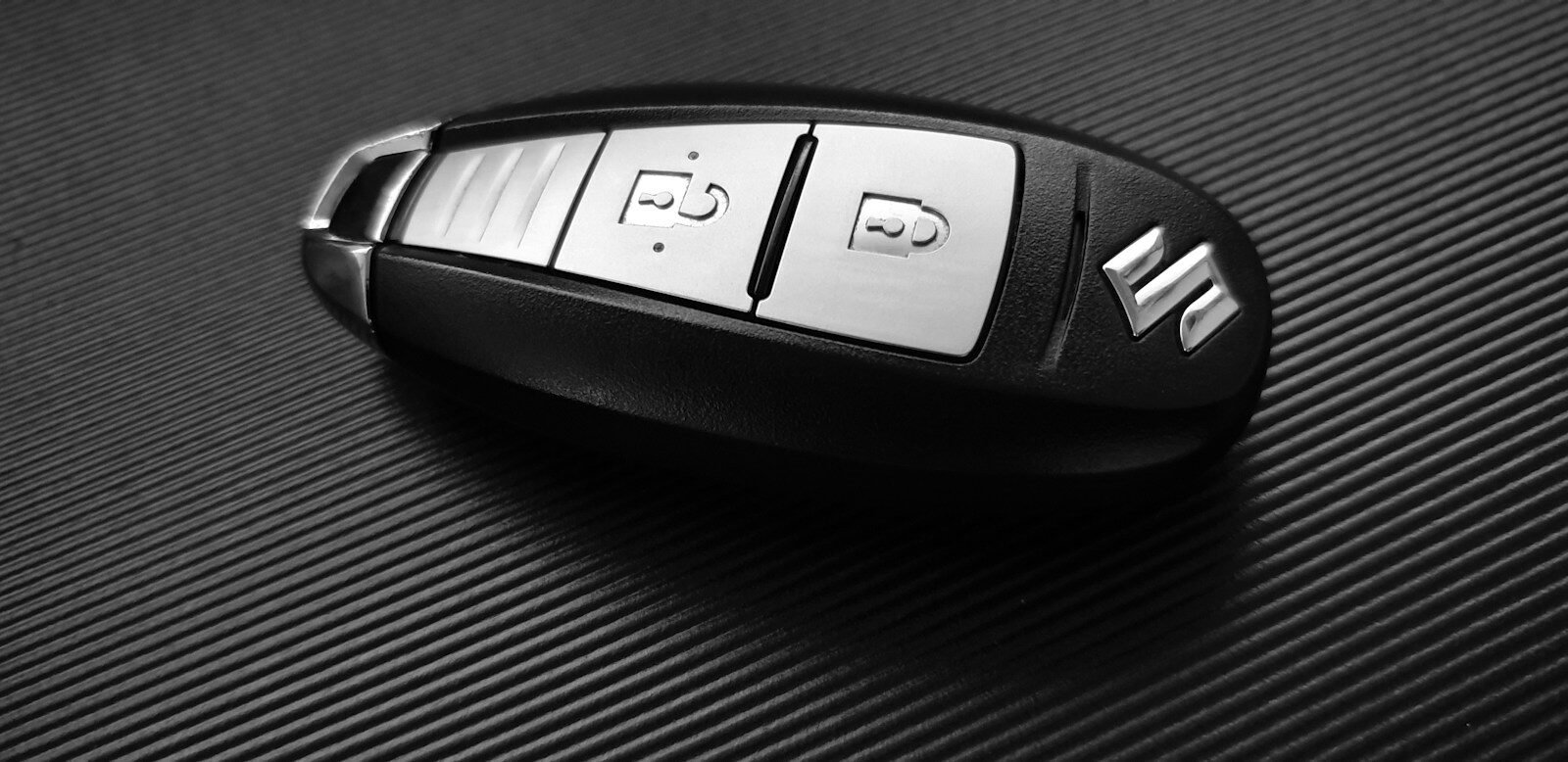
A four-button key fob is one of the smallest mechanical assemblies in a vehicle. The shell is often under 40 mm wide, the coin cell and antenna take most of the interior, and four buttons have to work in a stack a few millimetres tall. Engineers who have shipped these stop treating the dome as a part to choose and start treating it as a space to fit. The same dome that works in a steering wheel module causes trouble here, because the requirements that come with automotive applications assume more room than a fob has.
The dome is usually the last decision, not the first. Fix three numbers before you open a catalogue: interior height above the circuit, pitch between button centres, and the force you want the user to feel. Those three pick the dome diameter, the actuator and the seal. Get them wrong and no dome will save the design.
The sections below follow that order, because it is the order a compact fob forces on you.
Start with the stack height budget, not the dome
A fob keypad does not have a dome problem, it has a millimetre problem. Add up every layer between the circuit and the shell before choosing a part, and the dome becomes an output of that sum rather than an input.
Most compact fobs end up with 0.6 mm to 1.2 mm of stack between the circuit and the shell.
| レイヤー | Typical thickness | What it decides |
|---|---|---|
| Graphic overlay or keycap | 0.125 mm to 0.25 mm PET | Legend wear and press loss |
| Top adhesive | 0.05 mm to 0.10 mm | Bond line and overlay creep |
| Dome and retainer film | 0.10 mm to 0.40 mm high, film 0.05 mm to 0.10 mm | Travel and the click |
| スペーサー | 0.10 mm to 0.20 mm | Gap that lets the dome collapse |
| Circuit, FPC or rigid PCB | 0.10 mm to 0.20 mm | Pad geometry |
| Bottom adhesive or gasket | 0.05 mm to 0.15 mm | Seal to the housing |
What each layer costs the others
A taller dome clicks better but eats the height the spacer and keycap need. A thicker overlay prints better but absorbs force before the dome sees it. The usual mistake is capping the stack with whatever adhesive is on the shelf, which is the cheapest place to find 0.05 mm and the easiest place to lose the seal.
Read the constraint backwards
Subtract the overlay, dome, retainer and spacer from the clear interior height, and what is left is pre-travel plus keycap over-travel. On a compact fob that is often 0.2 mm to 0.4 mm. Shanyo lists travel options from 0.25 mm to 0.95 mm, which sounds generous until you remember the dome has to collapse inside the gap you already spent. Pick travel first, then dome height.
Match dome diameter to the button pitch
The dome has to fit between button centres, not inside a datasheet. On a compact fob the limiting number is pitch, the distance between two adjacent button centres, which sets the largest dome the layout can carry.
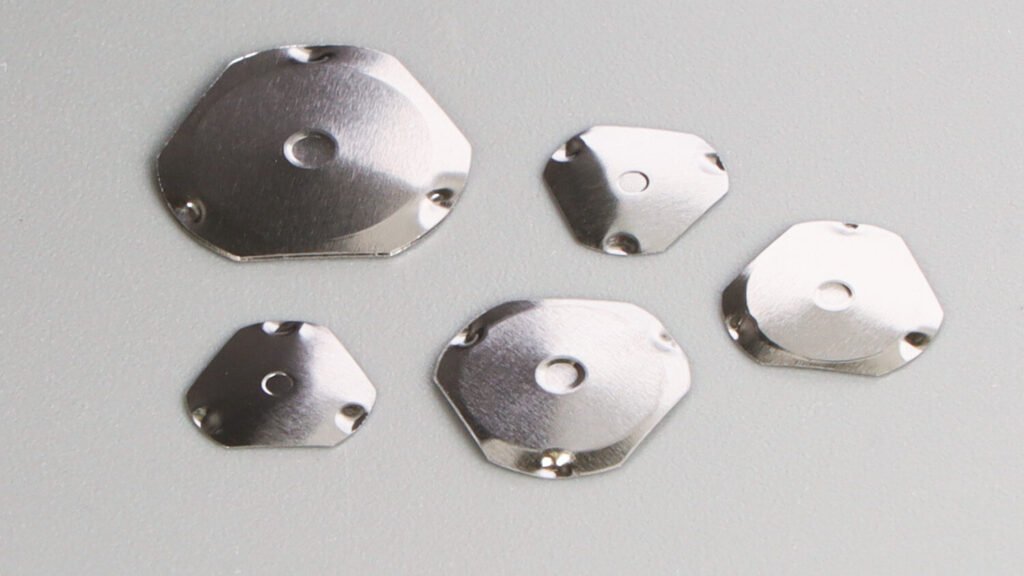
A 40 mm wide fob might leave 34 mm of usable interior. Four domes at 5 mm use 20 mm, leaving 14 mm across three gaps, so about 4.6 mm each. That works, and it is also where a designer is tempted by 6 mm domes and finds the gaps gone.
What happens when the dome is too wide
- Two keys fire at once, because one press rolls the overlay across both.
- The overlay domes upward and never sits flat, so legends wear unevenly.
- On four-leg domes, the support points land outside the contact ring.
A smaller dome is the only way to keep the pitch, and the force you can reach drops with it. That trade is worth settling before tooling.
Where a four-leg dome earns its place
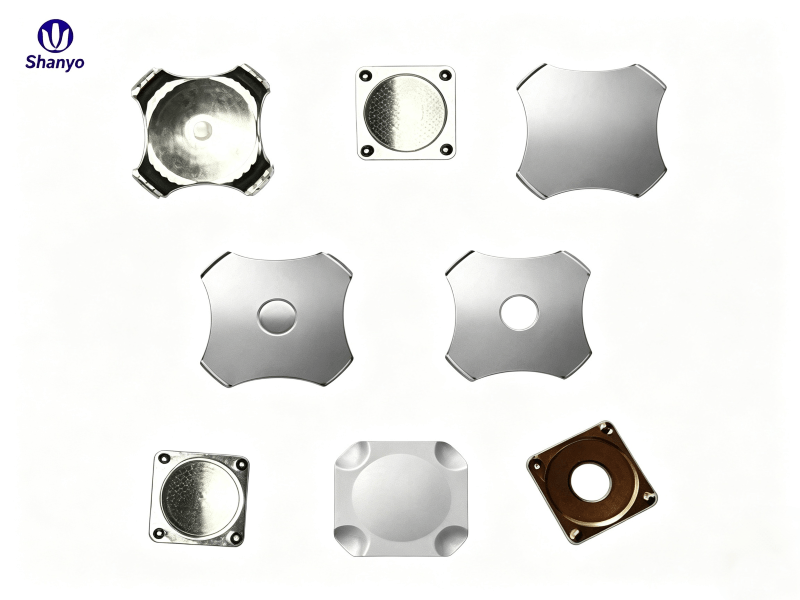
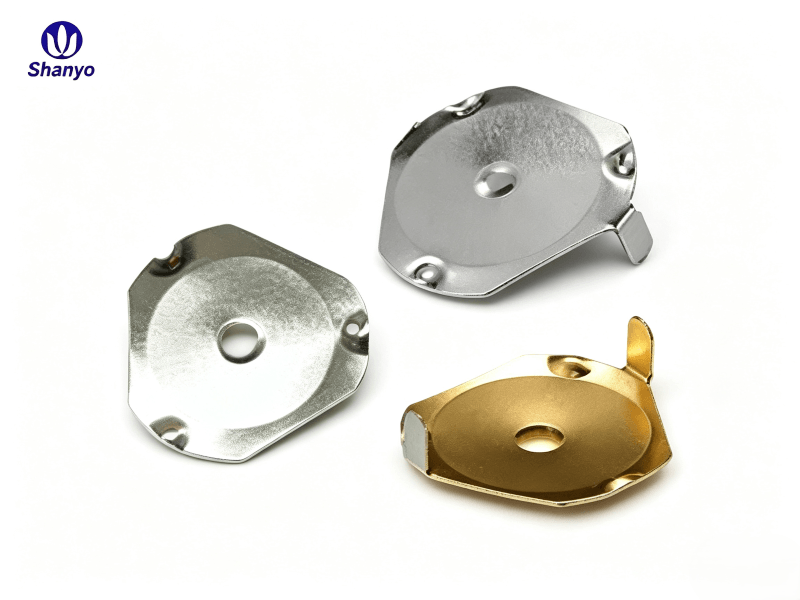
Four-leg domes hold position during assembly and leave space between the legs, so air can move inside a sealed fob. Round domes suit circular legends and spread load evenly. For four similar buttons in a grid, four-leg is easier to place. For a single panic key set apart, round is simpler.
Set actuation force against pocket presses and gloved thumbs
Most automotive remote programs land between 160 g and 280 g. Below that the fob fires in a pocket. Above it the button feels stiff to a thumb already holding a key ring.
A datasheet force is measured on a loose dome on a flat plate. What the user feels includes the overlay, keycap and actuator, so the number that matters is measured in the finished stack.
Why a light dome fails in a pocket
A fob shares a pocket with coins, a house key and a phone, and a light dome reads that weight as intent. The cost is a tailgate opening in a car park, or a panic alarm at six in the morning. Raising force is the blunt fix. Giving the keycap a defined rest position is the better one.
What force feels like through a plastic keycap
Thick polycarbonate caps transfer force well but add stiffness. Silicone keymats damp the snap and stiffen in cold, which is why the same dome feels heavier in a January car park than in a showroom.
Snap ratio is the other half of feel. Shanyo’s automotive selector runs from 40 percent to 65 percent, the drop between peak force and the force after the dome collapses. Wider reads sharper and louder. On a fob that lives beside a phone in a quiet car, 45 to 55 percent is enough.
Choose the actuator and keycap before the dome drawing
The actuator sits between the thumb and the dome, and it decides whether force arrives in the centre. A good dome with an off-centre actuator still clicks, at the wrong force and with uneven wear.
| Actuator | What it does | Where it goes wrong |
|---|---|---|
| UV-cured pip on the retainer film | Thin, light, direct | Limited height, tight clearance |
| TPU dimple | Softens contact, spreads load | Damps the click |
| Silicone keymat with moulded plunger | Returns the key, helps seal | Adds 0.3 mm to 0.6 mm, stiffens in cold |
| Moulded plastic keycap with post | Crisp feel, durable legend | Post alignment, off-centre presses |
Pre-load, over-travel, and the mushy button
A soft button is usually not a soft dome. Either the overlay holds the dome partly compressed at rest, the keycap travels past the snap and bottoms out, or the actuator sits off centre. Pre-load is common in thin fobs, and a dome held at 20 percent of its travel loses part of its snap.
Over-travel is worse for life. Past the collapse point, extra movement only fatigues the steel and presses the retainer into the pad. The fix is mechanical: a hard stop in the keycap, with the collapse point inside it.
Seal a small enclosure without killing the click
The dome seals nothing. Sealing comes from the overlay adhesive and a compressed perimeter gasket, and the rating you can claim is set by the weakest layer, usually the battery door.
Ingress protection follows the two-digit code in IEC 60529, first digit for solids, second for liquids. A fob claiming a liquid rating has to earn it at the battery door, the seam and the button openings at once. One good gasket and two poor ones give you the lowest of the three.
What the IP number does not cover
An IP rating describes an enclosure tested under defined conditions, not behaviour after two years of sweat and temperature cycling. Stainless steel handles corrosion and gold plating holds contact resistance stable, but neither helps if moisture reaches the pad through a failed adhesive line.
Venting a four-key fob
When the dome collapses, the air under the overlay has to go somewhere. In an open panel it escapes sideways. In a sealed fob with four keys and a tight spacer it does not, so the trapped pocket slows the return and flattens the click. A channel in the spacer adhesive, a vented carrier film, or a vent path to the battery compartment all work, and all are cheaper at the drawing stage.
Plan backlighting into the stack, not on top of it
Backlighting competes for the height the dome needs. If it is missing from the budget at the start, it ends up as a light guide film pressed onto an overlay with no room to travel.
A light guide film is usually 0.2 mm to 0.4 mm thick, plus a side-firing LED and a reflective layer. That is real height in a fob where the stack may be under 1 mm.
Where light bleeds between keys
At 4 mm to 5 mm between domes there is little to stop light from one key appearing under its neighbour, and a fob held against a dark door shows every leak. A black mask under the overlay, a dark spacer and a film edge kept clear of the next key are the usual fixes, and none work if the pitch was already too tight.
Pick the delivery format for the volume you actually have
Loose domes, dome sheets and dome arrays are the same part delivered three ways. The choice is about assembly, not performance, and on a four-key fob it comes down to how much placement error the layout can absorb.
| Format | How it is assembled | Fits when | Main risk |
|---|---|---|---|
| Loose domes on tape and reel | Pick-and-place, one dome per position | High volume, few keys | A shifted dome passes unnoticed |
| ドームシート | Domes on a PET carrier, placed by hand or fixture | Low to medium volume | Alignment depends on the operator |
| Dome array | Domes at fixed coordinates under one carrier | Multi-key layouts in volume | Tooling cost, layout locked once cut |
When an array stops being optional
Three conditions push a fob toward an array: four or more keys, a pitch tight enough that 0.1 mm of placement error reaches the pad edge, and a line that cannot inspect every key. An array turns placement into a tooling question instead of an operator question, and adds a spacer the loose-dome design did not need, which eats stack height.
Validate the keypad as an assembly, not the dome alone
Force, travel and contact resistance have to be measured in the finished stack, with the real keycap and overlay. A dome that meets its drawing on a flat plate can still fail once a 0.2 mm overlay sits on it.
- Force and travel through the assembled keycap, at the start and end of life
- Contact resistance drift, cold, hot and after humidity
- Temperature cycling across the automotive range, commonly minus 40 °C to plus 85 °C
- Drop, pocket abrasion and legend wear on the busiest key
- Life cycling to the program target, often 1,000,000 presses, then a return check
What IATF 16949 changes
IATF 16949 is the automotive quality management standard, overseen by the IATF, and it changes what a buyer can ask for. Process control, traceability and change notification become auditable records instead of promises.
Shanyo holds IATF 16949 certification, along with ISO 14001 and ISO 45001. In the Valeo metal dome case study, the certification question came up in the first technical exchange, before the part drawing was settled. The RFQ asked for a solderable dome with gold plating and selective tin plating, and the response included audit documentation and CCL forms ahead of a three-day on-site pre-audit covering cleanliness, tooling, stamping, testing and electroplating.
The feedback named the certification set and previous work with material as thin as 0.02 mm. It was a pre-audit, not an approval, and that distinction matters when a program judges how far along a supplier is.
よくあるご質問
Can a compact key fob keypad use a membrane switch instead of metal domes?
Yes, and sealed membrane keypads suit fobs that need a flat, wipe-clean face. The trade is feel. A membrane switch with a dome underneath still clicks, but the dome has to be larger to feel the same through the extra film. A flat membrane with no dome gives no click at all, which is why fobs that rely on the driver confirming a lock without looking keep the dome.
How thin can a four-button fob keypad get?
The stack itself can come down to roughly 0.6 mm to 1.0 mm with a 0.125 mm overlay, thin adhesive, a low-profile dome and a 0.1 mm circuit. The real limit is keycap travel above it. Add pre-travel and over-travel, and most compact fobs land nearer 1.5 mm to 2 mm for the button area.
Why does one button fail while the others still work?
Four domes on one circuit share the same environment, so a single failure points at something local. The usual causes are a contaminated pad under that key, an actuator sitting slightly off centre, an adhesive line that lifted at the overlay edge, or a keycap that bottoms out because the spacer beneath it was cut thin. None of those four is a dome problem, which is what makes the diagnosis worth doing before parts get replaced.