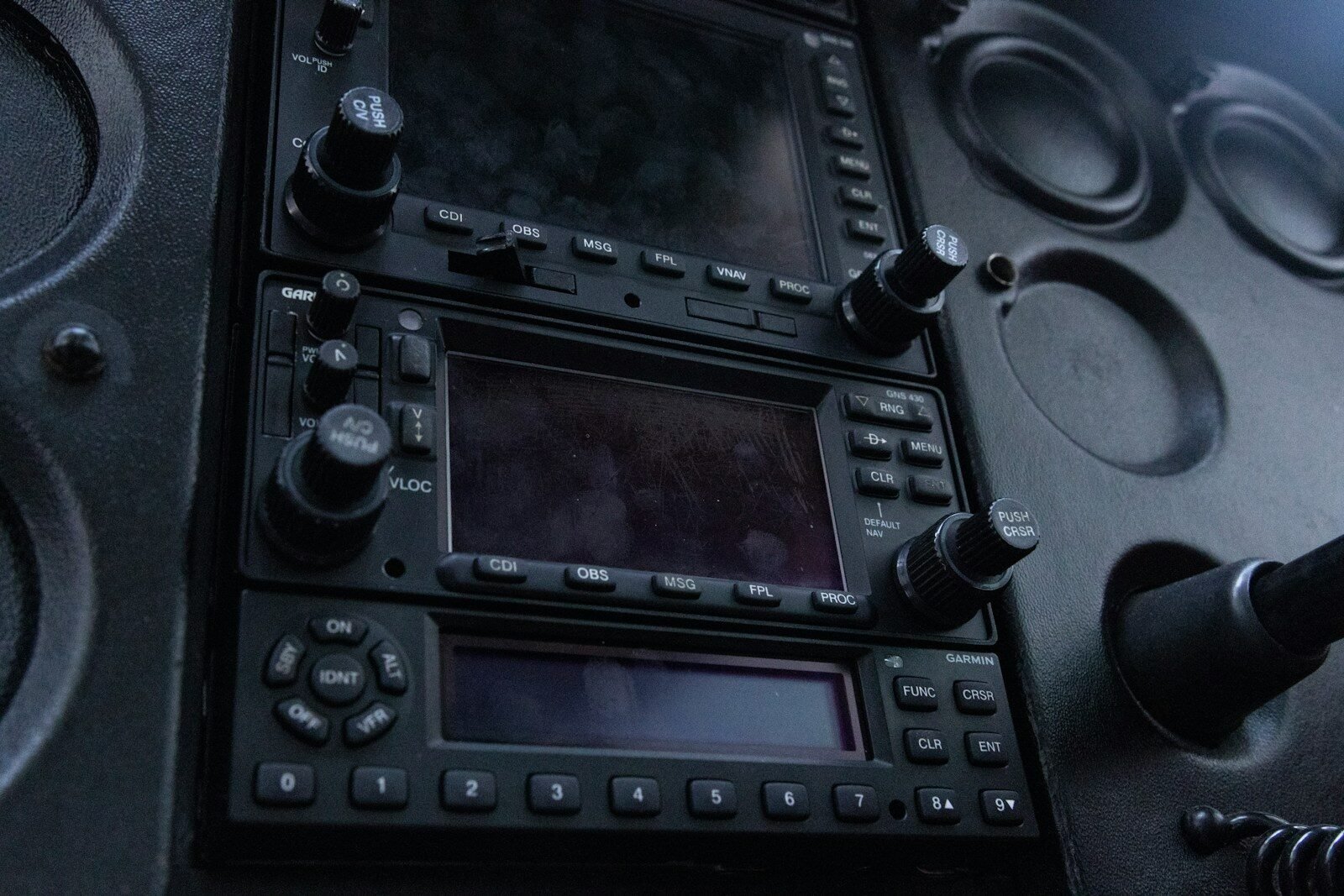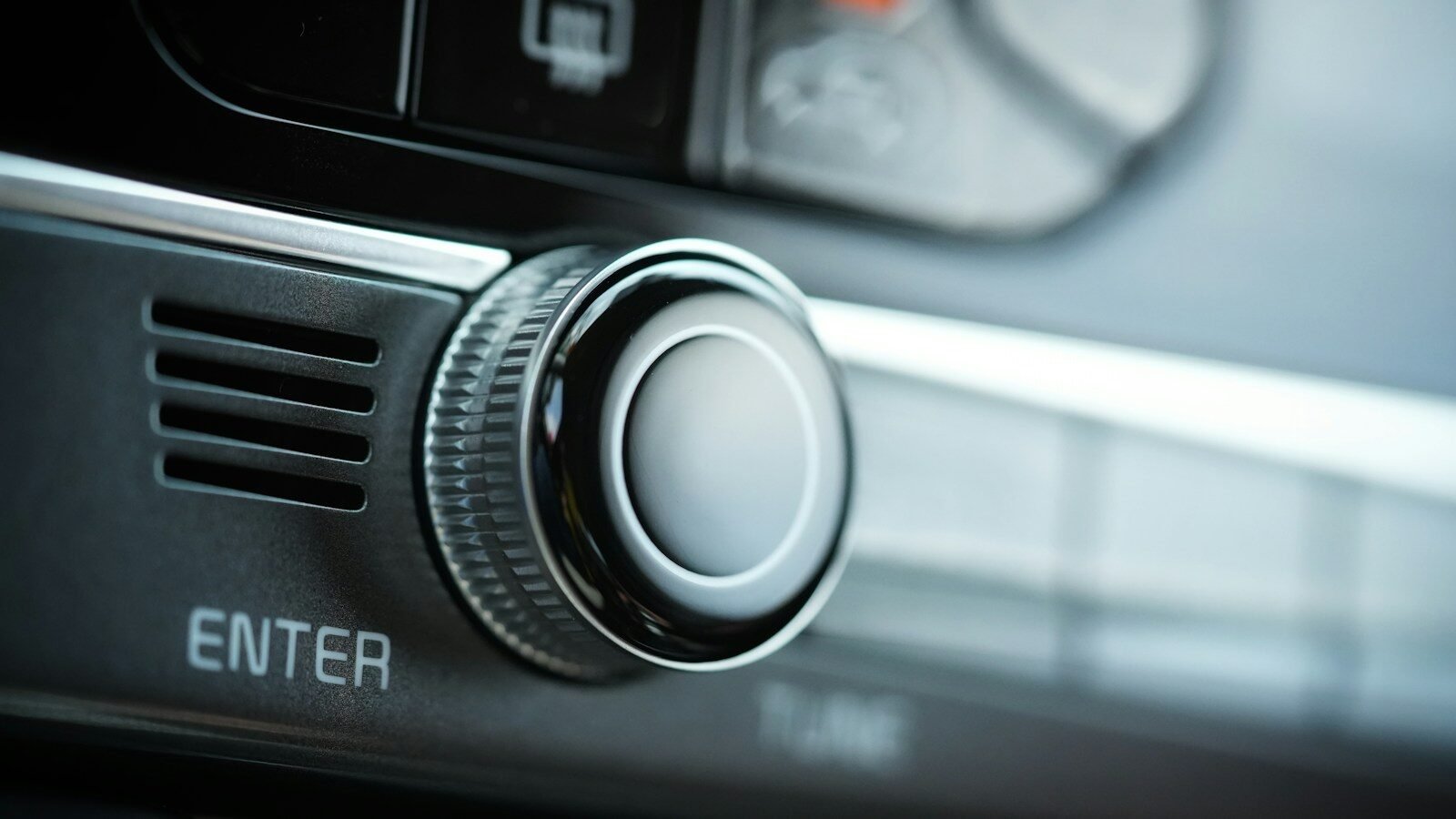
A car button lives a hard life. The panel above it bakes past 85°C in the summer sun, drops below freezing overnight, shakes for years of engine and road vibration, and gets pressed with wet or gloved hands. A switch that feels crisp on a lab bench can go soft or false-trigger two winters later, and the decision that causes it was made long before assembly. Almost every cabin button sits on the same small stainless-steel snap element, and the same selection decisions repeat across automotive applications that last the life of the vehicle.
Choosing a metal dome for an automotive switch means fixing five things in order: the actuation force the driver should feel, the shape and leg count the layout can hold, the material and plating that survive the cabin, the sealing the stack can achieve, and the delivery format your line can place. Every other number on a datasheet follows from those five.
This guide works through that order, with the ranges and trade-offs that matter at each step.
What a metal dome does in an automotive switch
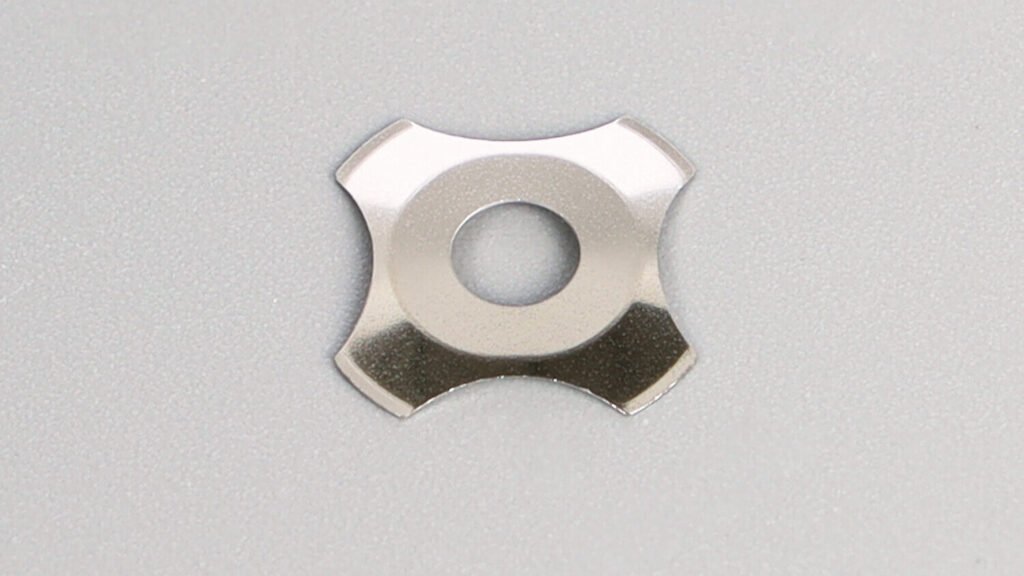
A metal dome is a momentary contact element. The crown collapses under a press, bridges an outer ring to a center pad, and springs back on release, so one action produces both the click the driver feels and the signal the module reads.
A cabin button has to confirm a press to a driver who is not looking at it. If the snap is vague, the driver glances down.
metal dome vs. rubber and carbon contacts
Rubber and carbon contacts still appear in low-cost panels, and they differ enough to be worth comparing before you choose.
| プロパティ | メタルドーム | Rubber dome | Carbon print |
| サイクル寿命 | 1M to 5M+ actuations | 100K to 1M | 100K to 500K |
| 温度 | Flat from -40°C to +85°C | Softens in heat, stiffens in cold | Drifts with humidity |
| Feel | パリッとした食感 | Soft and muted | Very light or none |
| 接触抵抗 | Low and stable | Rises as elastomer ages | Rises with contamination |
Rubber suits a rarely used button in a mild environment, not a control the driver touches every trip.
Set the actuation force before anything else.
Force comes first because it decides three things at once: whether the button feels deliberate, whether it fires by accident, and how long the dome survives. Most automotive interior controls land between 160 gf and 300 gf.
Below that band, a palm or pocket edge can trigger the button, which drains a key fob battery and unlocks doors in a parking lot. Above it the press becomes work. The answer is usually a range, checked against the thickest glove your market uses.
| Force band | Feel | Typical automotive fit |
| 100 to 160 gf | Very light | secondary keys, rarely pressed functions |
| 160 to 220 gf | Balanced click | climate rows, media, and menu buttons |
| 230 to 300 gf | Firm | center console keys, gloved use |
| Above 300 gf | Heavy | steering wheel pods, vibration-heavy controls |
Why higher force shortens cycle life
Force and life pull against each other. Hold diameter and thickness fixed, raise the snap force, and cycle life falls along a near-logarithmic curve. A four-leg stainless dome rated at 220 gf reaches a million cycles. The same geometry at 350 gf commonly lands between 500,000 and 700,000, and past 400 gf it can drop below 300,000 unless the design moves to five-leg or stacked construction. When you need both high force and long life, geometry changes before material does.
Match the dome shape, size, and leg count to the button
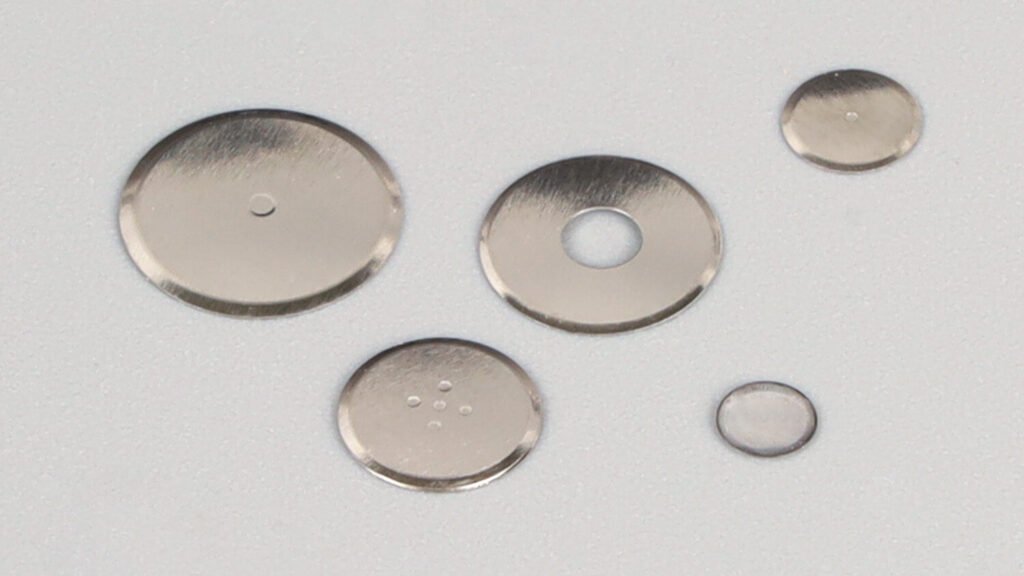
Shape follows the pad and the keycap, not the other way round. Round, oval, square, and triangle domes each snap differently, and the leg count decides how the dome is supported and how air leaves the cavity under it.
Diameter sets travel, and the keycap height is the panel’s need. Domes around 4 to 6 mm suit thin shells and short travel, which is why key fobs use them, while 8 to 12 mm domes give a deeper press but need more room above the circuit. All of these shapes sit in the same custom tactile metal dome family, and the differences that matter are mechanical rather than cosmetic.
| 形状 | Behavior | Best fit |
| ラウンド | Even load spread, predictable snap | tight cavities, single buttons |
| オーバル | Travel biased along one axis | panels short in one direction |
| 正方形 | Larger contact area for the same footprint | wide rectangular keys |
| トライアングル | Compact, defined corners | irregular layouts |
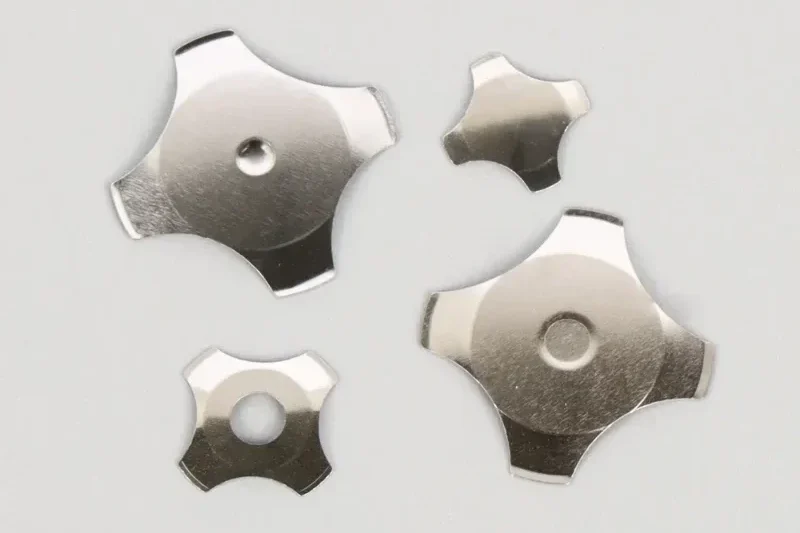
| 4本足 | Support feet with air gaps between them. | button grids and arrays |
| Five-leg | Better self-centring | large keys above 300 gf |
Contact patterns are not interchangeable. A square dome will not sit correctly on a pad designed for a round one, and swapping them changes both the force curve and the contact stability.
Four-leg, five-leg, and the air path
Air has to leave and re-enter the cavity on every press. Four-leg domes offer a natural route between the feet, which is one reason they dominate multi-key panels. A vent that ends in a sealed pocket traps air and dulls the snap, and a vent that wanders opens a path for moisture.
Choose material and plating for the cabin environment.
Stainless spring steel gives the dome its snap, and the plating decides whether contact resistance stays flat for fifteen years. SUS301 and SUS304 are the standard grades, and gold is the plating that holds up best in a car.
Thickness usually runs from 0.05 to 0.15 mm depending on the force target. A stainless dome keeps nearly the same force curve from -40°C to +85°C, and short excursions to +125°C do not permanently deform it. Vibration matters less than it looks, because a dome weighs a fraction of a gram. Moisture is the real risk, and the dome cannot solve it alone.
| メッキ | 耐食性 | Contact resistance over life | Relative cost | Typical automotive use |
| Bare steel | Basic | Rises with humidity | 最低 | Not recommended in a cabin |
| Nickel | グッド | Stable, typically under one ohm | ミディアム | General cabin buttons |
| Gold | 素晴らしい | Lowest and most stable | Highest | Safety-related, low-current signals |
| Silver | グッド | Lowest at first, sensitive to sulfur | ミディアム | Low-resistance, clean-environment contacts |
Sealing is a property of the whole stack, not the dome. The overlay, adhesive layers, spacer and vent routing together decide the ingress rating, and a well-built dome sheet stack typically reaches IP65. Temperature, humidity and vibration levels for the finished part are normally written against ISO 16750, the international standard for environmental testing of equipment in road vehicles, which sets stress levels by mounting location rather than by product category.
Decide between loose domes, dome sheets, and dome arrays
The difference between formats is who owns the dome position. Loose domes leave placement and retention to the assembler, while a dome sheet or dome array holds every dome at a fixed coordinate under a carrier, so a whole multi-key panel registers in one operation.
| Format | Registration | Line efficiency | Best fit | Main risk |
| Loose domes | Set by the operator | Low, one dome at a time | Prototypes, single keys | Misalignment, trapped debris |
| ドームシート | Carrier holds position | ミディアム | Panels with a fixed layout | Carrier lift over time |
| Dome array | Die-cut carrier, fixed coordinates | 高い | Multi-key panels, high volume | Tooling lead time and cost |
For a large automotive panel the array is usually the answer, because it turns a dozen alignment decisions into one. The trade-off is tooling, and the earlier the layout is frozen, the cheaper that tooling gets.
Qualify the supplier and the first production lot
Ask a supplier for the force-displacement curve, the lot tolerance and the test method behind the life rating. A vendor who can answer those three on the first call is worth quoting, and a datasheet alone proves very little.
Put these in the request for quotation:
- Actuation force in gf with a tolerance in percent
- Snap and release forces from the force-displacement curve
- Tactile ratio target
- Dome diameter and leg count
- Material grade and plating
- Cycle life rating with the test method used
- Snap force drift across the operating temperature range
- Lot sampling plan and inspection quantity
Force and geometry stay consistent between lots only if tooling, forming and incoming inspection are stable, so batch-level force checks and clear change notification matter more than a single qualification report.
Frequently asked questions
How long does a metal dome last in a car switch?
An automotive-grade dome is typically rated for one million actuations, and premium designs go past five million. It usually outlives the button around it. Most early failures trace back to contamination, over-travel or a rocking keycap rather than to the metal wearing out.
Is a metal dome waterproof on its own?
No. The dome is a conductor and a spring, not a seal. Water resistance comes from the overlay, adhesive, spacer and vent design around it. A well-sealed stack can reach IP65 or higher, but a bare dome has no ingress rating.
Can I swap a four-leg dome for a round dome?
Only if the pad and the actuator change with it. The two shapes have different contact patterns and support geometry, so the same keycap gives a different force curve and contact position. Swapping them without re-checking force and contact resistance is how a panel turns intermittent.