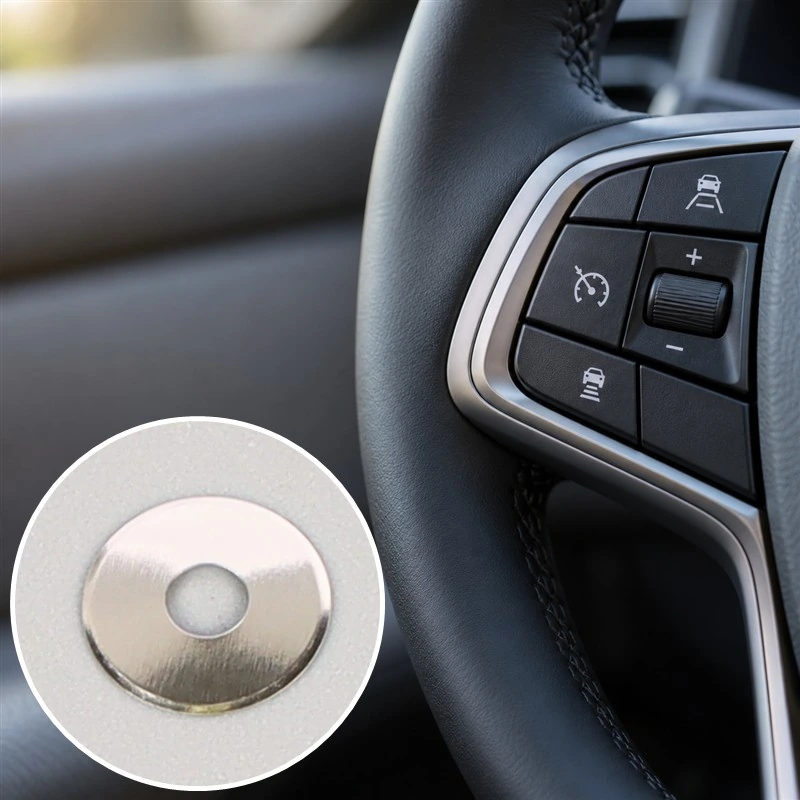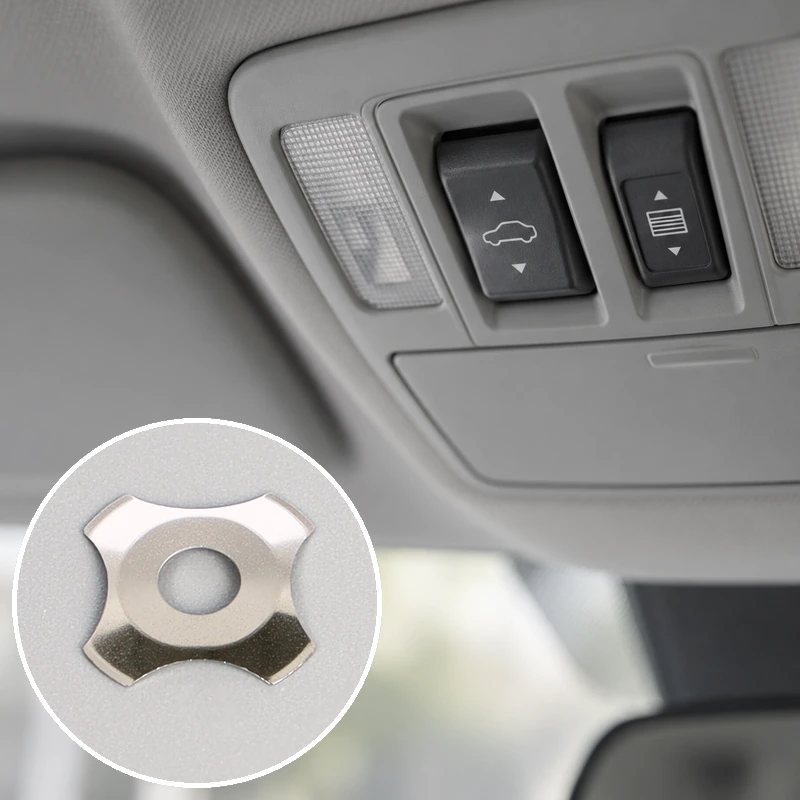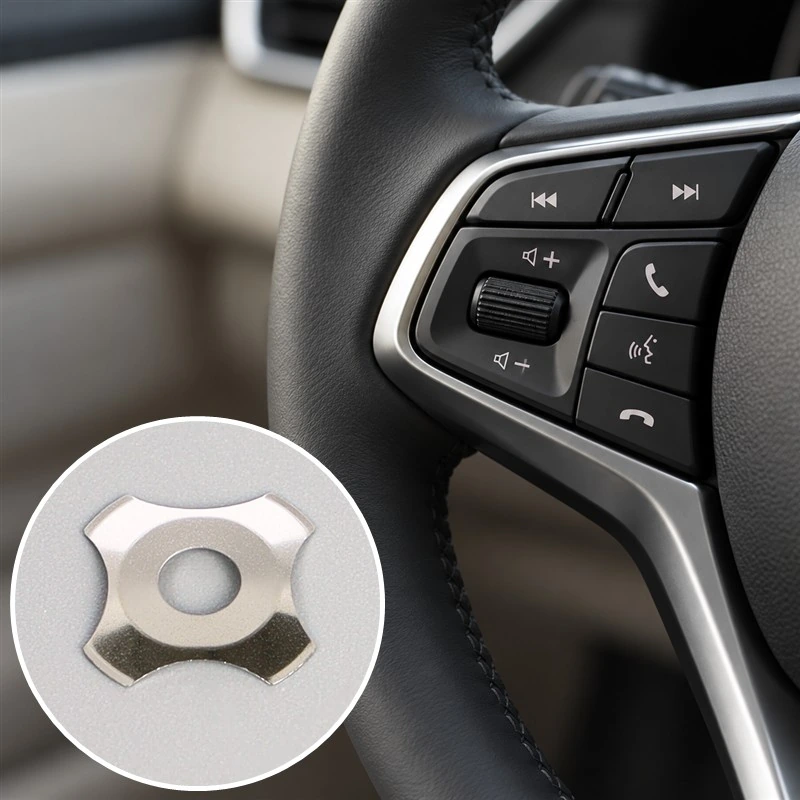
A driver reaches for the volume key, then the cruise key, and one lands with a crisp click while the other gives way with a soft, vague push. Nothing has failed. Both keys probably meet their drawings. The complaint is never really about one button. It is about the difference between two buttons that are supposed to feel the same. On a multifunction wheel, that difference is a tolerance stack problem that starts at the stamped dome and ends at the keycap, and it is solved in the drawing and the sampling plan long before the first wheel is built. The same problem shows up across automotive applications where several keys share a small surface.
Consistent feel comes from controlling four variable groups at the same time: the force spread of the domes themselves, the thickness and alignment of the layers above and below them, the preload introduced during assembly, and the drift caused by temperature and contamination over the vehicle’s life. A dome chosen well but stacked badly will feel worse than a mediocre dome stacked correctly.
What follows is how each of those variables moves the feel and how to write a specification that keeps every key inside one narrow band.
Why consistent feel matters more than one good button
A single button that feels excellent proves very little. What a driver judges is the wheel as one object, so the target is not a peak force on one key but a band narrow enough that every key in the cluster stays inside it, on the first press and on the ten-thousandth.
Drivers build muscle memory from the wheel, not from a single key. Once the thumb learns that a press needs a certain effort, a key that needs noticeably less feels broken in the wrong direction, and a key that needs more feels stuck. Either reaction costs a second press, and a second press costs a glance. US DOT guidance on in-vehicle controls recommends that tasks be completable with glances away from the road of two seconds or less and twelve seconds in total, based on the same research that links long glances to crash risk (US Department of Transportation, guidelines release, checked 19 October 2026). A button that confirms itself through the thumb is the cheapest way to stay inside that budget, and it only works if the confirmation is the same every time.
Which functions share the wheel, and how often they get pressed
A modern wheel carries three loads with very different press counts:
- High-frequency keys. Volume, mute, track skip, and scroll wheels may be pressed dozens of times in one trip.
- Medium-frequency keys. Cruise set, resume, and cancel are pressed a few times per journey, but while the driver is already busy.
- Low-frequency keys. Voice activation, lane assist, and other driver assistance toggles are pressed rarely, so an accidental press matters more than fatigue.
That split is why mixed force on one wheel is deliberate rather than sloppy. Light keys for high-frequency functions keep the thumb from tiring. Firmer keys for assistance functions reduce accidental activation. The inconsistency drivers complain about is not the intended difference between groups. It is unintended variation inside a group, where two keys that should match do not.
What actually sets the feel of a steering wheel button
The dome sets the snap, but the hand feels the whole stack. Every layer between the thumb and the contact pads either transmits that snap faithfully or absorbs part of it, and each layer carries its own tolerance.
| Capa | What it contributes to feel | What drift in this layer does |
|---|---|---|
| Keycap or overlay | Lever ratio between thumb and dome | A thicker cap or a pivot further from centre softens the perceived snap |
| Spacer or dome sheet | Sets free height above the dome | Too thin and the dome is preloaded, so the click starts late or disappears |
| Cúpula metálica | Peak force, snap ratio, travel | Spread between domes changes key-to-key force |
| Contact pads on FPC or PCB | Contact resistance, and the flat seat the dome needs | Oversized cutout lets the dome sit low and feel mushy |
| Housing and bezel | Locates the key, limits overtravel | Flex or misalignment tilts the cap and loads the dome off-centre |
Read the table as a chain rather than a list. A 10 percent low dome in a stack with a 0.05 mm oversize spacer can feel acceptable, while the same dome under a tight spacer feels dead. This is why swapping to a tighter dome tolerance alone often fails to fix a mixed-feel complaint.
Where the dome sits in the stack
Three dimensions in this area cause most of the trouble. The first is the PCB or FPC cutout under the dome. If the opening is wider than the dome’s support ring, the dome sits below the board surface and loses part of its travel before it snaps. A common rule is to keep the cutout at roughly 60 to 70 percent of the dome diameter (Shanyo metal dome engineering guide, checked 19 October 2026). The second is spacer height, usually 0.1 to 0.3 mm, which exists to stop the overlay from resting on the dome. The third is total stack height, including cap and bezel tolerances. When those three numbers are only checked on a drawing, the first article tells you nothing about the thousandth wheel.
How does a metal dome produce the snap drivers feel?
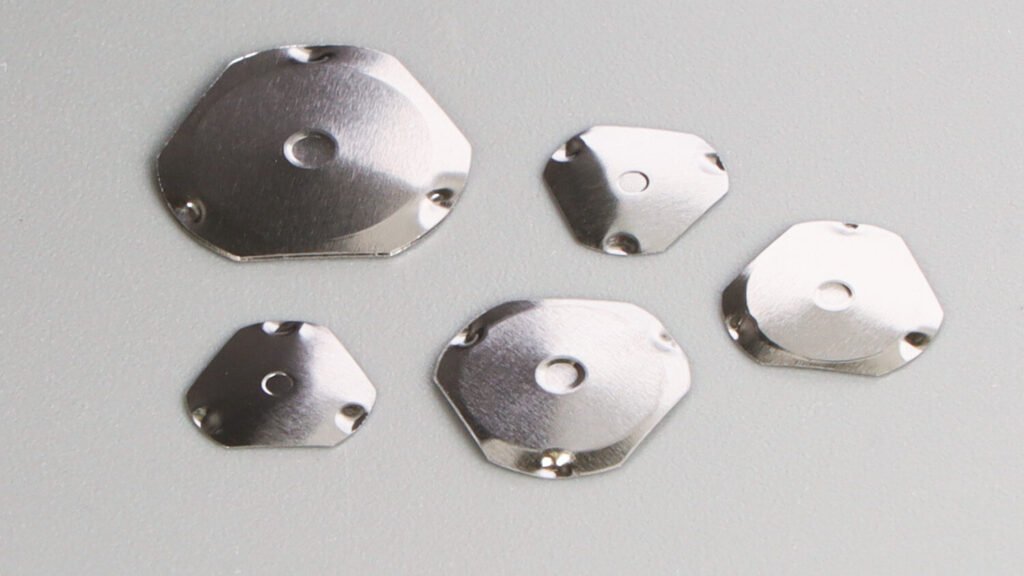
A thin stamped stainless disc holds a shallow curved shape until the thumb pushes past a peak force, at which point the curve buckles inward and the centre strikes the contact pads below. That buckle is the click. Release, and stored elastic energy snaps the disc back and opens the circuit again.
The behavior is easiest to read as a force-displacement curve. Force rises to a peak, drops sharply as the dome passes through, then rises again as the key bottoms out. Three numbers on that curve decide what the thumb feels.
| Parámetro | Definition | Typical automotive value |
|---|---|---|
| Actuation force (F1) | Peak force before the dome buckles | 250 to 350 gf for steering wheel keys |
| Release force (F2) | Force at which the dome returns | Set by geometry, typically well under F1 |
| Ratio de chasquido | (F1 minus F2) divided by F1 | 40 to 60 percent, with 45 to 55 percent common in premium designs |
| Viajar | Deflection from rest to contact | 0.2 to 0.5 mm |
| Resistencia de contacto | Resistance across closed contacts | 100 mΩ or lower depending on plating |
| Rated life | Actuations before force falls out of band | 1 million for standard automotive grade, 5 million and above in premium designs |
Those ranges are typical rather than universal, and the exact numbers belong on the drawing for each key.
Reading the curve the way a driver feels it
A high snap ratio feels crisp because the force drops fast after the peak. The thumb reads that drop as a distinct event. A low ratio feels soft and rolling, which suits an oval key on an ergonomic panel but reads as vague on a wheel. There is a trade-off hidden in the number: pushing the ratio up concentrates stress in the same small area of metal, and cycle life falls. Ratios near the top of the range belong on low-traffic keys, not on the volume button.
Travel is small, so tolerance is not
With only a fraction of a millimetre between rest and contact, small errors take a large share of the stroke. A 0.05 mm shift in spacer thickness is a few percent of total travel on a thin stack, which is enough to change when the snap arrives. This is the physical reason steering wheel switches are harder to keep uniform than a large appliance panel with the same dome. The parts are smaller and the margin is thinner, so the working tolerance is tighter and the supplier’s process control matters more than the catalogue range. Buyers comparing quotes on this component are usually comparing process capability, not metal; the fabricante de cúpulas metálicas who can hold force spread across a lot is the one whose parts feel identical in the wheel.
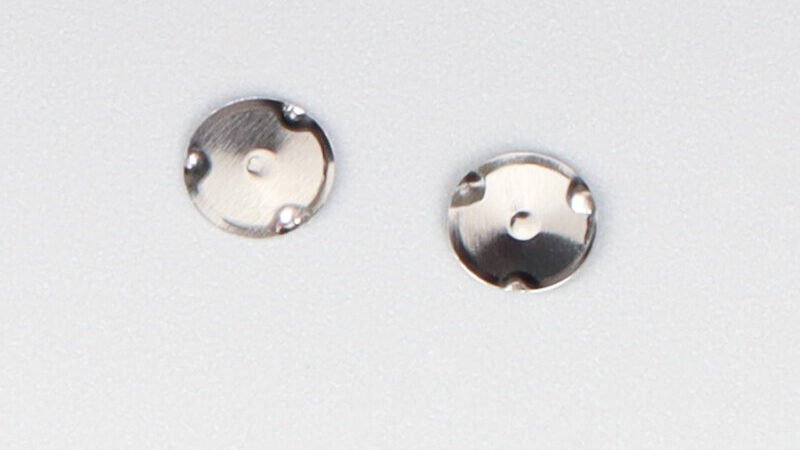
Why do buttons in the same wheel end up feeling different?
Four sources of variation stack on top of each other: the force spread between domes, the tolerance of the layers around them, the alignment and preload added during assembly, and drift from heat and contamination in service. Fixing one source while leaving the others open usually moves the problem instead of removing it.
Dome-to-dome force spread
Standard domes are commonly supplied to plus or minus 15 percent on actuation force, with plus or minus 10 percent available from manufacturers set up for tighter sorting (Shanyo metal dome engineering guide, checked 19 October 2026). Inside that band, two domes from the same box can differ enough for a driver to notice when they sit side by side on one spoke. Spread has three main causes: variation in strip thickness and temper, differences in heat treatment between batches, and plating thickness on the contact side. Batch-to-batch variation is the harder problem, because it appears months after the first samples were approved.
Stack and keycap tolerances
The dome’s rated force is measured with a flat probe. A real keycap transfers force through a pivot, so the thumb meets something different from the number on the datasheet. A large cap over a small dome reduces the effort needed; a small cap over a large dome raises it. Two keys built from the same dome but drawn with different cap geometry will not feel the same, and no incoming inspection of domes will reveal it.
Placement, adhesive, and preload
Dome arrays are die-cut and placed as a sheet, typically to plus or minus 0.1 mm. That accuracy is good, but placement is not the only assembly variable. Adhesive squeeze-out under the sheet, a vent path blocked by adhesive, or a bezel that presses lightly on the overlay can all preload the dome. Preload is the quiet failure: the dome is partly compressed at rest, so the first part of the stroke is spent recovering rather than building toward the snap. The key still works. It just feels flat.
Temperature and contamination
Cabin temperatures swing from below freezing to well above 80°C, and steering wheel switches are usually qualified across minus 40 to plus 85°C. Force drifts across that range, and a specification should state how much drift is allowed rather than assuming none. Contamination works differently: dust or oil under the dome changes contact stability and can cause an intermittent press, but it rarely changes the snap itself. When a driver reports that a key has gone soft, the dome is usually not the worn part. Something has moved in the stack.
How to hold the feel inside a tolerance band in production
Write the feel as a set of measurable numbers with tolerances, then defend those numbers with sampling, capability data, and lot traceability. A drawing that says “crisp tactile feedback” cannot be inspected, and a specification that cannot be inspected cannot be held.
| Specification item | How to write it | How to verify it |
|---|---|---|
| Fuerza de accionamiento | Nominal value in gf with tolerance, for example 300 gf plus or minus 10 percent | Force-displacement gauge on a sample from every lot |
| Ratio de chasquido | Target with a minimum, for example 0.50 minimum | Same gauge, calculated from F1 and F2 |
| Full curve, not just peak | Requirement to record force at defined travel points | Curve comparison against the approved golden sample |
| Force after life test | Maximum permitted fall after rated cycles, commonly 10 to 15 percent | Cycle test to rated life, then re-measure |
| Resistencia de contacto | Maximum value at defined test current | Four-wire measurement on sampled parts |
| Temperature drift | Permitted force change across the qualified range | Thermal chamber run at cold, ambient, and hot |
| Lot traceability | Strip heat number, plating batch, and forming lot on the label | Records review at incoming inspection and during audit |
Two habits do most of the work in production. The first is recording the force curve at cycle one and again at the end of rated life, because drift shows up directly on the overlay of the two curves. The second is a fixed sample size per lot, commonly around 30 pieces measured on a force-displacement gauge, with the results plotted as capability rather than pass or fail. Capability data tells you whether the process will still be inside the band in six months, which a single passing sample cannot.
Process control on the dome side matters just as much: strip incoming inspection, controlled heat treatment, tool wear monitoring and scheduled re-sharpening, and plating thickness checks, since plating sits on the contact surface and shifts both resistance and force. Shanyo runs these steps under an IATF 16949 quality system, which is the framework most automotive customers require before a PPAP submission is even discussed.
What is a haptic feedback steering wheel, and does it replace domes?
The term covers two different systems. One is a wheel that vibrates to warn the driver through a motor in the rim or column. The other is a control surface that generates its own tactile confirmation electronically, through actuators under a capacitive panel. Only the second competes with a metal dome, and even then it usually keeps a mechanical layer underneath.
The warning system is about alerts: a short vibration for a lane departure and a stronger pattern for a collision warning. It has nothing to do with how a button feels when pressed. The active control surface is different. A capacitive layer senses the thumb, a spring-damper mount allows a small movement, and a voice coil actuator pushes back to simulate a click. One published study of active haptic steering wheel controls set its push feedback threshold at 4 N and its release threshold at 2 N, which is firmer than most passive keys (ACM study on active haptic feedback preferences, checked 19 October 2026).
| Passive metal dome key | Active haptic key | |
|---|---|---|
| Source of feel | Mechanical snap from the disc | Actuator waveform, tuned in software |
| Feelings can be changed after build | No, only by changing parts | Yes, by changing firmware |
| Part count per key | Dome, sheet, spacer, contacts | Capacitive sensor, actuator, mount, controller |
| Failure mode | Wear, contamination, stack drift | Electronics, actuator, calibration drift |
| Feel consistency across keys | Set by tolerance stack | Set by calibration, one unit at a time |
| Coste por volumen | Bajo | Higher, plus validation of the electronics |
The comparison points to a split rather than a replacement. Active surfaces let a designer reshape a key after tooling is cut, which is valuable on a surface that changes function by menu. They also add cost, calibration work, and electronic failure modes. For safety-related keys, most designs keep a mechanical snap under the surface, so the driver gets confirmation even if the actuator or its supply fails. The metal dome is not being displaced. It is being asked to be predictable.
What should you ask a dome supplier before releasing the drawing?
Ask about tolerance, drift, and test method. A supplier who answers those three with numbers and records can hold a feel band. A supplier who answers with adjectives cannot.
- What force tolerance can you hold on this geometry, and is it sorted or process-controlled?
- What is the measured spread across the last ten lots, not just the sample you sent?
- Which test method and gauge do you use, and can I see a force curve rather than a single peak value?
- How much force loss do you permit across rated life, and how is it verified?
- What is the plating thickness range, and how does it affect contact resistance?
- Which change points require a new PPAP submission, including strip supplier, heat treatment, and tooling repair?
- What does your incoming inspection plan look like for the layers above the dome, if you supply the full stack?
The last question matters more than most buyers expect. A supplier who assembles the dome sheet can control preload in a way that a dome-only vendor cannot, and preload is where consistency is usually lost. Shanyo’s work on a Tier-1 pre-audit for Valeo covered exactly this ground, from cleanliness and tooling through stamping, testing, and electroplating, and it shows what an automotive customer checks before approving a line (see the supplier pre-audit case study for the sequence).
PREGUNTAS FRECUENTES
Will the buttons feel different after three or four years of use?
Within rated life, usually not enough to notice. Stainless spring steel resists fatigue, so snap ratio and force stay close to the original curve across a million actuations or more. When a key does change early, the cause is normally contamination under the dome, an impact that deformed it, or a stack that shifted, not normal wear.
Can one dome array carry keys with different forces?
Yes, and many wheels are built that way. A sheet can be populated with domes of different diameters, shapes, or force ratings so that volume keys feel light and assistance keys feel firm. The practical limit is tooling and inspection complexity: each force group needs its own placement position and its own sample check per lot.
Why does a brand new wheel sometimes have one key that feels soft?
Softness at zero kilometres is almost always a stack issue rather than a dome issue. The usual causes are a spacer that is slightly thin for that position, a cap sitting fractionally lower, adhesive or a blocked vent adding preload, or a dome seated off-centre in its cutout. Measuring the force curve of the finished key, not just the dome, is the fastest way to tell which one it is.