Consumer electronics teams usually reach the metal dome decision late, after the enclosure, board, and overlay artwork are fixed. Anyone specifying a custom tactile metal dome for a remote, an earbud, or a wearable is answering three questions at once: how big the dome can be, how hard it should be to press, and which outline behaves predictably in that footprint.
A custom metal dome for consumer electronics is defined by three parameters that cannot be separated. Diameter sets the force and travel the dome can deliver, actuation force sets how the key feels, and shape decides where the dome contacts the circuit and how it handles off-center presses. Most consumer devices work within 3 mm to 12 mm diameter, 100 gf to 350 gf force, and a round, four-leg, triangle, or oblong outline.
The sections below take each of the three in the order you would specify them, then show how they combine under a real button.
What size options are available for a custom metal dome?
Diameter comes first because it sets the limits for everything else: a dome can only deliver a certain force range and travel at a given diameter. Consumer electronics mostly use 3 mm to 12 mm, with 6 mm to 10 mm covering the largest share of remotes, handhelds, and appliance panels.
Diameter bands and the force each band supports
The table below summarizes ranges commonly published for round and four-leg domes. Treat it as a starting point, not a catalogue of guaranteed combinations.
| 직경 | Typical force | 여행 | Character | Consumer use |
| 3 to 5 mm | 100 to 180 gf | 0.10 to 0.20 mm | Short and sharp | Earbuds, watch buttons |
| 6 to 8 mm | 150 to 280 gf | 0.20 to 0.35 mm | Balanced, crisp | Remotes, handhelds, key fobs |
| 10 to 12 mm | 200 to 400 gf | 0.30 to 0.50 mm | Deeper, softer snap | Appliance and audio panels |
| 14 to 20 mm | 250 to 500 gf | 0.40 to 0.60 mm | Firm, heavy click | Rare in handheld devices |
The bands overlap because diameter and force are linked by material stress. Push a small dome toward a very high force, and the steel sits close to its limit, so the snap flattens out or the dome cracks after a few cycles. Run a large dome at a very low force, and a knock can close the circuit on its own.
Height, thickness, and travel
Dome material is usually 0.05 mm to 0.15 mm thick, and travel across common consumer sizes falls between roughly 0.10 mm and 0.50 mm. A taller dome gives a more pronounced click but consumes stack height. In thin products, the space shared with the carrier film, adhesive, and spacer often decides the diameter.
Matching dome diameter to button cap and PCB pad
Two fits matter. The printed key on the overlay should be wider than the dome, so a press anywhere inside the printed area still lands on it. On the board, the center pad has to be sized carefully: too small and the dome snaps without bridging the inner and outer traces, and too large and it bottoms out against the board without snapping, removing the tactile feedback entirely.
Which actuation force should you specify?
Actuation force should follow from how often the key is pressed and what an accidental press would cost, not from a general preference for a firmer button. Most consumer electronics settle between 150 gf and 280 gf. Wearables and light-touch interfaces sit below that, and only protective or rarely used functions justify going above 350 gf.
Force bands and press frequency
| Force band | Feel | Press frequency | Consumer use |
| 100 to 180 gf | Light and quick | Very high | Volume keys, wearables |
| 180 to 300 gf | Balanced, definite | 높음 | Remotes, handhelds, keypads |
| 300 to 500 gf | Firm, deliberate | 낮음 | Power and reset keys |
| Above 500 gf | Heavy | 매우 낮음 | Uncommon in consumer devices |
Force is quoted in gram-force on most dome datasheets even though the gram-force is not an SI unit, which matters when a dome feeds into a system-level force budget expressed in newtons. The NIST conversion-factor table gives 1 kgf = 9.806 65 N (NIST SP 811, Appendix B.8), so 1 gf = 9.806 65 mN.
Trip force, return force, and snap ratio
The peak figure on a datasheet is the trip force, the load at which the dome collapses. The return force, measured as the dome springs back, is what users perceive as crispness when the gap between the two is wide.
Snap ratio = (trip force – return force) / trip force, expressed as a percentage.
Consumer keys commonly sit between 40 and 60 percent. Below that the button feels soft; above it the click turns harsh and harder on the material. Two domes can share a 200 gf trip force and still feel quite different, so specify return force as well, and state whether the figure was measured on the loose dome or in the finished stack.
Why force cannot be chosen independently of diameter
Very high force in a small diameter approaches the limit of what the formed steel can hold, and very low force in a large diameter leaves a dome that responds to vibration rather than intent. When a project needs a force outside the natural window for its footprint, the fix is usually to change the footprint, shape, or actuator.
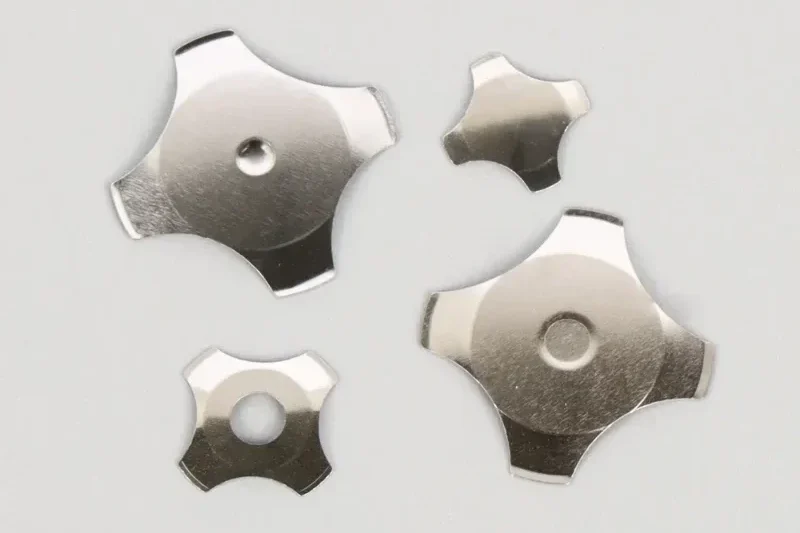
What shape options exist, and what does each one change?
Shape decides where the dome contacts the circuit, how the press load is distributed, and what happens when a press lands off-center. Round, four-leg, triangle, and oblong outlines cover most consumer electronics work, and each is a different trade between tactile clarity, service life, and layout flexibility.
| 모양 | Contact | Tactile character | Off-center press | Layout fit |
| Round | 연속 스커트 | Softer, muted snap | Most tolerant | Needs a squarer footprint |
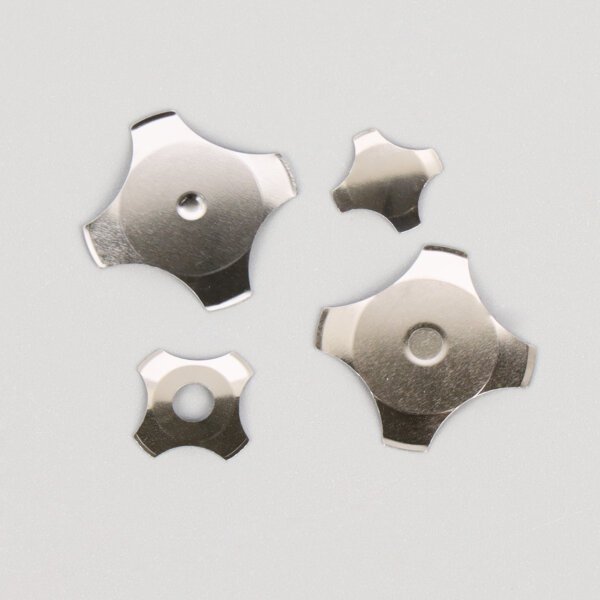
| 네 다리 | Four points | Crisp, clear click | Good, load shared. | Legs leave the routing room. |
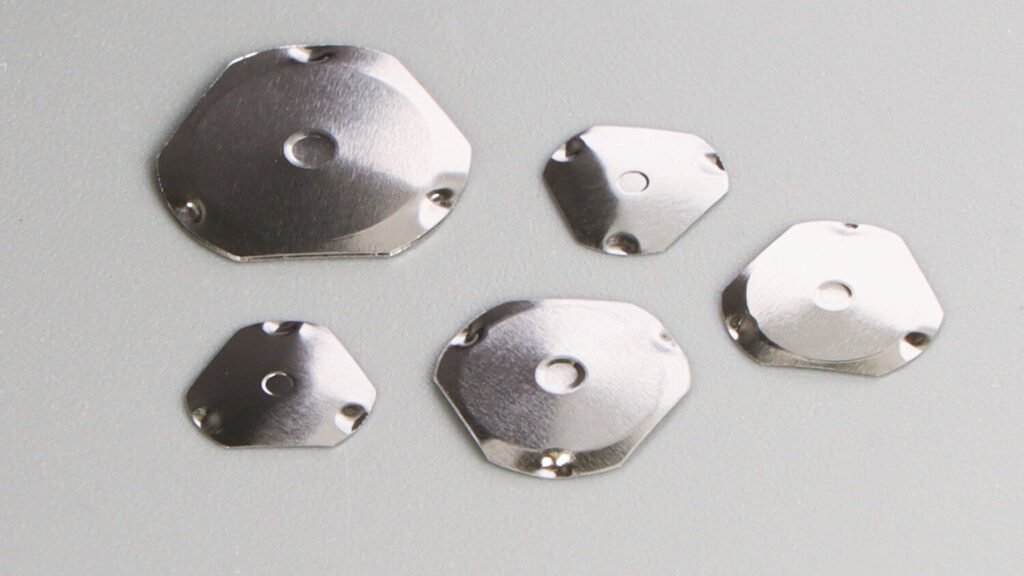
| 삼각형 | Three points | Sharp and stiff | Can rock | Tight or irregular areas |
| 직사각형 | Two or four | Softer, longer travel | Prone to teeter | Elongated keys |
For high-frequency consumer keys, the four-leg outline is the usual default, because the load is spread symmetrically and the gaps between the legs give traces somewhere to run. Round outlines suit keys that also need sealing or devices where a loud click is unwanted. Triangle outlines fit small or irregular footprints, and oblong outlines suit elongated keys such as a rocker or a plus-minus strip.
Dimples, center holes, and feet
A center dimple concentrates the press into a single contact point and shortens the dead travel before the snap, so a dimpled dome feels noticeably sharper than the version without one. Center-hole variants tune contact behavior or clear a light pipe.
How size, force, and shape come together on the finished button
The figure on a dome datasheet describes the dome on its own. What a user feels is the dome plus the actuator pushing it, the overlay above it, the preload built into the stack, and whether air can escape from underneath.
Actuator geometry, overlay thickness, and preload
A sharp, narrow actuator concentrates the load at the center and makes the dome feel lighter than its rating. A flat, wide actuator spreads the load toward the skirt and can raise the effective force substantially, so a dome specified at 300 gf can feel closer to 500 gf once installed. Preload is the other lever: designing the spacer or overlay to rest lightly on the dome removes the dead travel, so the button feels tight from the first press.
Off-center presses, air venting, and tolerance stack-up
Users rarely press dead center. Four-leg and round outlines tolerate this well, while triangle and oblong outlines can tilt instead of snapping. Air trapped under a sealed dome resists collapse and damps the click, which is one reason legged outlines vent naturally through the gaps between the legs. Dome height, carrier film, adhesive, spacer, and overlay tolerances also accumulate, so specify a tolerance window rather than a nominal figure, and keep domes to one lot at one force tolerance when a keypad must feel identical key by key.
How custom metal domes are delivered for consumer production
Delivery format is a production decision, but it must be settled before tooling because it determines the carrier, the packaging and the placement method.
Loose domes suit prototyping and repair runs. For multi-key consumer keypads, using custom metal dome arrays on a PET carrier holds every dome in position on an adhesive film, so the whole set is placed in one operation, keeping alignment and reducing handling damage. Automated lines take domes on carrier tape instead.
Frequently asked questions
Can a single keypad use different dome sizes and forces?
Yes, and mixed layouts are common: a numeric pad pressed hundreds of times a session takes lighter domes, menu keys take a mid-range force, and a power or reset key that must resist accidental presses takes a firmer one. What makes this work in production is documentation, with a dome table that maps every labelled key position to its own diameter, force and shape.
How long will a custom metal dome last in a consumer device?
Service life follows from diameter, force, material and snap ratio rather than from a single number. Start by calculating the presses the key will see: presses per session, sessions per day, and expected years of service. Dome families are commonly published with ratings from a few hundred thousand cycles up to several million, with the higher figures belonging to larger, rounder geometries at a moderate force.
How do I confirm the button feel before committing to production tooling?
Test in the stack, not on the bench. Force measured on a loose dome can differ noticeably from force measured once the dome sits under the overlay with the real actuator above it. Build a sample using the production overlay, spacer, and actuator; compare candidate domes at roughly 20 to 30 gf steps; then measure trip and return force with the fixture that will be used for production checks.