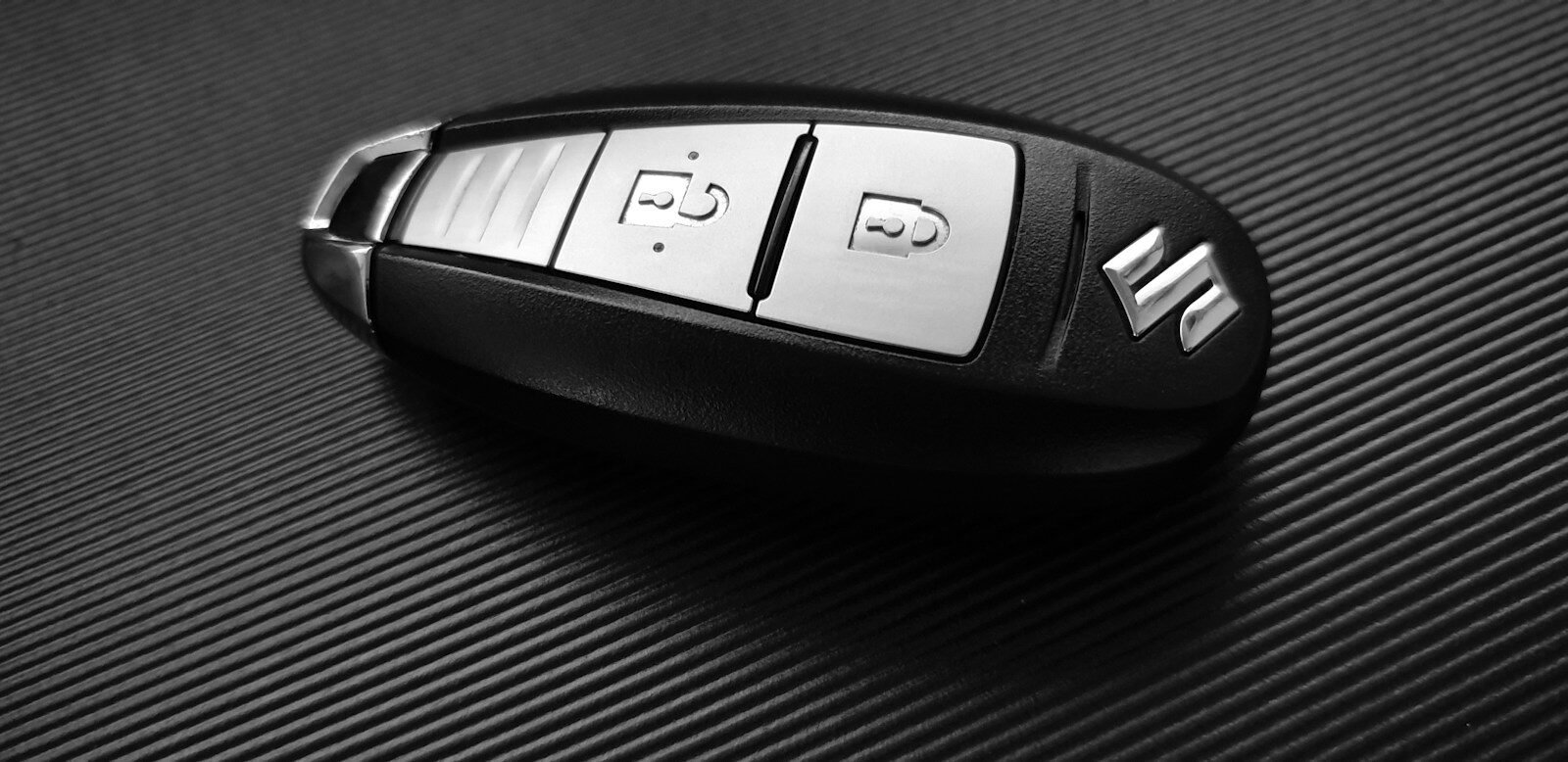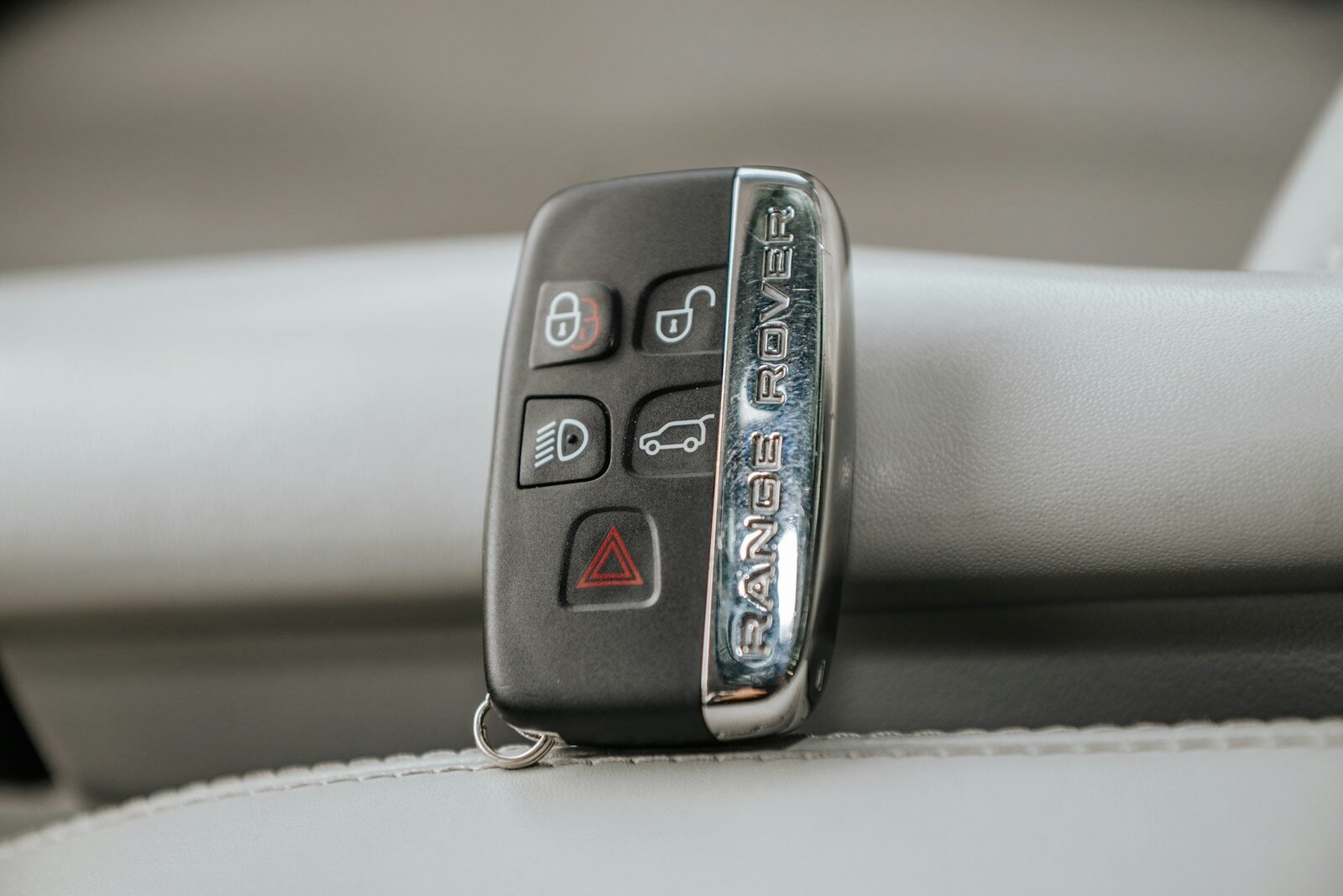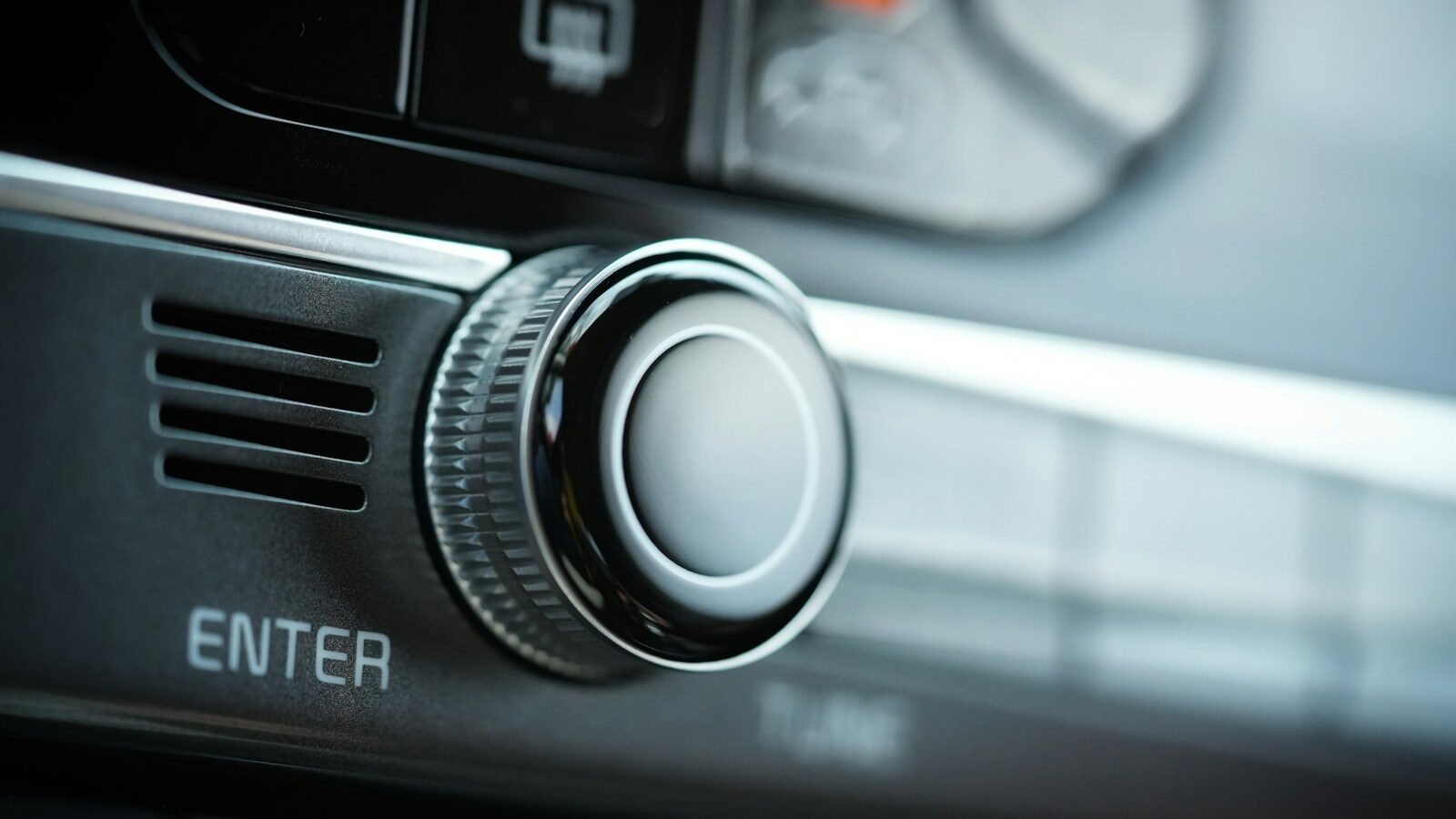
A center console button has three jobs at once: read clearly at night without lighting the windshield, confirm a press through the fingertip alone, and sit flush enough that the trim looks like one surface. In most programs the backlight belongs to the optical group and the click to the mechanical group, and the specs get written months apart. They meet for the first time on a sample. The conflict runs through automotive applications across the cabin, but every automotive metal dome program meets it hardest at the console.
Treat the button as one optical and mechanical stack, not two features. Fix the force and travel window first, then build the light path around it: a center-hole dome with the LED underneath, a light guide segmented per button, dead-front ink that stays dark until the car is on. Then qualify the assembled key on a force-travel curve and a light-bleed check together.
The order matters more than any single number.
Why the two requirements collide
They compete for the same few tenths of a millimeter above the crown of the dome. That sliver is the only place light reaches the legend, and it is also where the plunger pushes. Every tenth given to mixing distance comes out of travel or preload.
A console key stacks an overlay, a legend, adhesive, a plunger, the dome on its carrier, and the circuit underneath. Each layer is there for a reason: the overlay is thick because it gets cleaned with solvents, the chamber deep because a shallow one shows hot spots. None of those choices is wrong alone. Together they can bury a metal dome button that was fine in a fixture.
What the finger is actually measuring
A fingertip reads three things: how hard the key pushes back, how far it moves, and how sharply resistance drops when it gives. The third is the click. Click ratio is peak force minus the lowest force after snap, divided by peak force, times 100. A dome peaking at 300 gf and settling at 120 lands at 60 percent. Published dome data puts tactile snap domes at 40 to 60 percent; below roughly 35, most fingers stop registering a snap.
| المعلمة | Effect on feel | Effect on the light path | Console-typical value |
|---|---|---|---|
| Actuation force | Light, firm or heavy | None directly | 180 to 500 gf |
| Click ratio | Crisp or mushy | A flat drop hides under a soft overlay | 40 to 60 percent |
| Preload | Kills rattle, adds heaviness | Pulls the keycap toward the guide | Minimum that stops play |
| Overlay thickness | Cushions and flattens the snap | More material for light to cross | 0.5 to 1.0 mm |
What the light path needs from the same space
Light wants a short path, a centered source, and a wall it cannot climb over. A wide-angle LED under a bare legend lights the neighbor as well as the icon; narrow it and the legend center burns while the edges go dim. The fix is a chamber with reflective walls and a diffuser, exactly the volume the plunger wants.
The second cost rarely reaches a drawing. The overlay bends before the dome loads, so the force the finger feels is not the force the dome sees. A 55 percent dome can read as 40 percent at the fingertip. The light did not ruin the click. The stack built to carry it did.
Which automotive metal dome structure carries light without killing the click
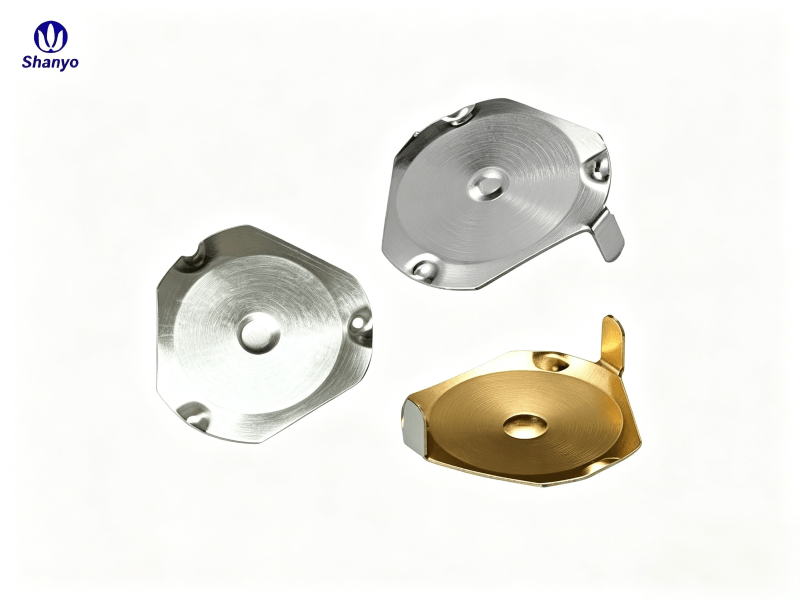
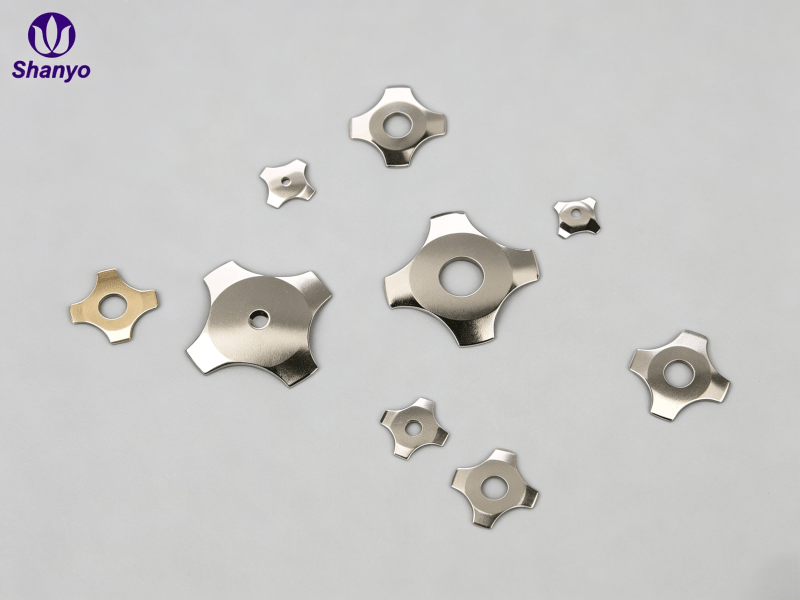
A center-hole, four-leg dome is the default for a backlit console key. The hole lets the LED sit on the same side of the board as the contacts, so light travels a millimeter or two to the legend instead of crossing the substrate, and the legs hold the part steady while leaving gaps for routing.
Center hole domes and where the LED sits
The hole is the optical window, a locating feature, and a second path for air. That last job matters: a sealed perimeter under a sealed overlay traps a pocket that must move aside on every press, and with no vent the dome squashes instead of snapping. A solid dome over an LED is worse than a dark spot, because the crown lands on the diode every press.
Shanyo’s center-hole series runs 5 to 12 mm in diameter with holes of 1.0 to 3.0 mm, forces of 180 to 500 gf, and click ratios of 55 to 65 percent in SUS301, rated -40 to +85 °C at 1,000,000 cycles and up (Shanyo product data, October 2026). Keep the hole smaller than the smallest legend feature and the light stays inside the icon.
Geometry choice for console strips
| الشكل | Support | Routing under the dome | Backlit console fit |
|---|---|---|---|
| مستديرة | Continuous rim, best seal | Awkward | Good if the hole is large |
| أربعة أرجل | Four discrete feet | Easiest, traces between legs | Best all-round |
| المثلث | Three points, compact | معتدل | Rare, for keys that resist a false press |
| مستطيل | Long, narrow envelope | معتدل | Long keys and rocker strips |
A console row is its own case. Six to twelve switch points can live on one dome sheet on a shared carrier, which holds spacing and keeps force consistent across the climate strip. Domes placed one at a time drift, and a metal dome switch pressed off center raises felt force and cuts the drop.
When a solid dome with an offset light guide wins
If the key is 4 mm across, the hole removes too much of the crown and the curve gets hard to hold. If the legend is a long thin line, a side-emitting LED feeding a light pipe spreads it more evenly than a point source through a small hole. The trade is a longer optical path and one more part.
How much force should a center console button need
Most console keys feel right at 2.5 to 3.0 N at the keycap, and the dome is usually specified a step below that, because overlay stiffness and preload add force before the finger feels it. The overlay also flattens the drop, which turns a crisp dome into a soft key.
Force targets by operating zone
Ergonomics work on automotive push-return switches found drivers preferred 2.5 to 3.0 N across seven interior locations, with 2.5 N best in a tapping zone and 3.0 N in reaching and grasping zones (Journal of the Ergonomics Society of Korea). A key by the shifter is a tapping zone. A key at the far edge of a wide console is not. Hazard and drive mode should also resist a sleeve or a bag.
Travel, preload and over-travel
Dome travel is 0.15 to 0.35 mm on standard parts. Keycap travel is different, usually a couple of millimeters, and most of it disappears before the dome loads: overlay flex, air gap, plunger take-up.
- Give the housing a hard stop so over-travel is carried by structure, not by the dome.
- Keep preload to the minimum that removes rattle, and confirm it from the assembled stack, not from CAD.
- Leave over-travel after contact, or the key drops out across the tolerance band.
Click ratio: what makes it crisp
The ratio is a shape, not a magnitude. Two snap domes at 250 gf can feel completely different depending on where the force lands after the snap, which is why a force figure alone is not a specification. Return force also drops in the cold, so test at the extremes.
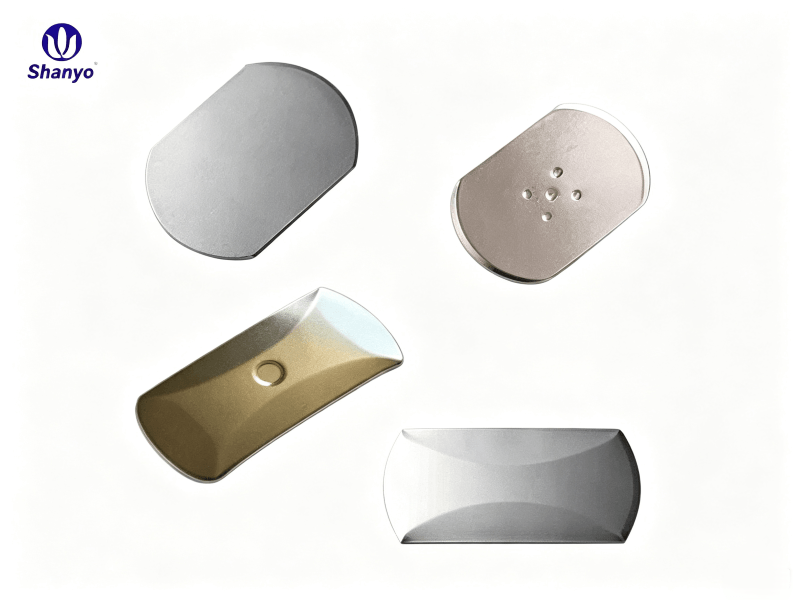
How to stop light bleed without adding stack height
Segment the light instead of diffusing it. Put an opaque wall or black absorbing frame between every independently lit zone, keep each chamber short and close to the legend, and tune the dead-front ink so an unlit key reads as solid trim.
Dead-front printing and transmission targets
Dead-front printing is what makes a console look like a surface instead of a switch panel. The legend is translucent ink on the underside of the overlay, the surrounding area opaque. Off, the key looks like trim. On, the icon appears.
The failure modes pull opposite ways. Print too transparent and sunlight bounces off the parts underneath, so unlit icons cast a shadow on black. Print too dense and the LED has to be driven harder, which costs current and shifts color. Stacks that work land around 3 to 8 percent transmission unlit.
Segmented light guide film and light chambers
A guide film does two things when asked to serve a whole console: it spreads light across the panel, and it carries light between buttons. The first is useful. The second is the defect.
- One guide per button, or per group that always lights in the same color at once.
- Never let two zones share a continuous reflector, diffuser, or clear adhesive. Each is a bridge.
- Cut slots only with a black absorbing border, because a cut edge becomes a new extraction surface and can move bleed rather than stop it.
Where it usually goes wrong
A few tenths of gap between guide and overlay is enough for light to travel sideways. So is a wide-angle LED with no chamber, a diffuser over the whole panel, or an RGB key sharing a guide with white keys. Raising current makes all of it more visible, and the fix is structural.
How to test the balance before tooling
Test the assembled key, not the dome and the guide on their own. Clamp the real overlay, adhesive and housing, then record a force-travel curve and a light-bleed photo from the same sample.
Force-travel curve on the real stack
Read four points off both branches: peak force, the force it drops to, the displacement where contact closes, and how it recovers. Test five to ten samples, then repeat after life and environmental conditioning. Press the edge of the key as well as the center, because fingers land off center.
Write the window into the drawing while samples are on the bench. A drawing that says 250 gf with no window is read as 250 gf at the dome, at 23 °C, on a rigid plate.
Optical checks
Judge bleed against the neighbor, not against a brightness target. Photograph the panel in a dark booth with one key lit and the next one dark, then repeat in daylight to catch ghosting. Check uniformity across the legend and look at edge sharpness. Then dim to the bottom of the night curve and look at the windshield; lit controls that reflect in the glass are a safety issue.
Environment and life
Run thermal shock from -40 to +85 °C, humidity, vibration, and salt spray where plating is exposed. Then run to a million cycles and measure the curve again. Contact that still closes is not the pass criterion. Force and click ratio moving less than the agreed window is.
How to hold the balance in production
Write the window rather than the point, and keep dome, carrier adhesive, overlay and light guide inside one supplier’s scope. A drawing that asks for 250 gf will deliver parts from 200 to 300, and a stack validated at one end will not match one built at the other.
State the make point, how far the curve may move after cycling, and which surface the measurement is taken on. The carrier adhesive needs its own line, because it has to hold the dome and still let it move.
One owner removes the argument about whose tolerance caused the failure. Shanyo holds IATF 16949 certification and runs 100 percent force-curve inspection on critical lots with PPAP documentation. A recent Valeo automotive metal dome program shows the sequence: Valeo metal dome case study.
When a backlit metal dome is the wrong choice
Skip the dome when the surface has to be one unbroken pane, when the key count is two or three, or when the interface needs sliding and pressure sensing. A capacitive panel with a haptic actuator does the job.
That is the honest answer, and it is also the wrong one for the functions regulators now score. European crash testing began scoring direct physical controls for indicators, wipers, hazards, horn and the emergency call button in its 2026 protocols (Euro NCAP, 2026), and its position is that a touch surface gives no tactile confirmation, so attention goes to the task instead of the road. The usual result is a hybrid: a backlit dome strip for climate, glass for the rest.
Frequently asked questions
Does a center hole in a metal dome weaken the click?
It changes the curve, and the forming specification is set with the hole in place, so the force you buy is the force of the finished part. What you cannot do is change the hole diameter after the die is cut and expect the curve to stay put.
Can one light guide film serve every button on a console?
Only if every icon lights at the same time in the same color. The moment one zone has to stay dark or change color, the guide splits, along with any reflector or clear adhesive it shares with its neighbor.
How bright should center console buttons be at night?
No universal figure exists, and a supplier who quotes one is guessing. Set the night level against the instrument cluster so the two dim together, keep it low enough that lit legends do not reflect in the glass, and check the bottom of the dimming curve.