Physical buttons are coming back to the center console. A decade of folding climate, audio and hazard functions into touchscreens is being reversed by safety protocols that reward switches a driver can find without looking. For teams working in automotive applications, the metal dome switch stops being a low-cost commodity and becomes a part that has to survive a ten-year warranty, a sunny dashboard and a cupholder two centimetres away.
Validate the whole switch stack against the console’s real duty cycle, not the dome against its own datasheet: the force-displacement curve and remaining travel under the actual overlay, contact resistance and bounce at the module’s signal level, a plating system chosen for cabin sulfur rather than the lowest initial resistance, force and resistance re-measured after thermal and life conditioning, chemical and vibration exposure at passenger-compartment severity, and the supplier’s IATF 16949 system with a part-specific approval file behind it. A number on a dome drawing is an input, not evidence.
The order matters, because each check removes options the next one would otherwise have to accept.
Why does a center console button need its own validation plan?
Because the failure drivers here are time, heat, contamination and perceived quality, not press count. A console button may see a few tens of thousands of presses in a vehicle’s life, well under the million-cycle rating of a typical snap dome, yet it sits in solar heat for years, shares a panel with a spill source, and has to feel the same on year ten as it did in the showroom.
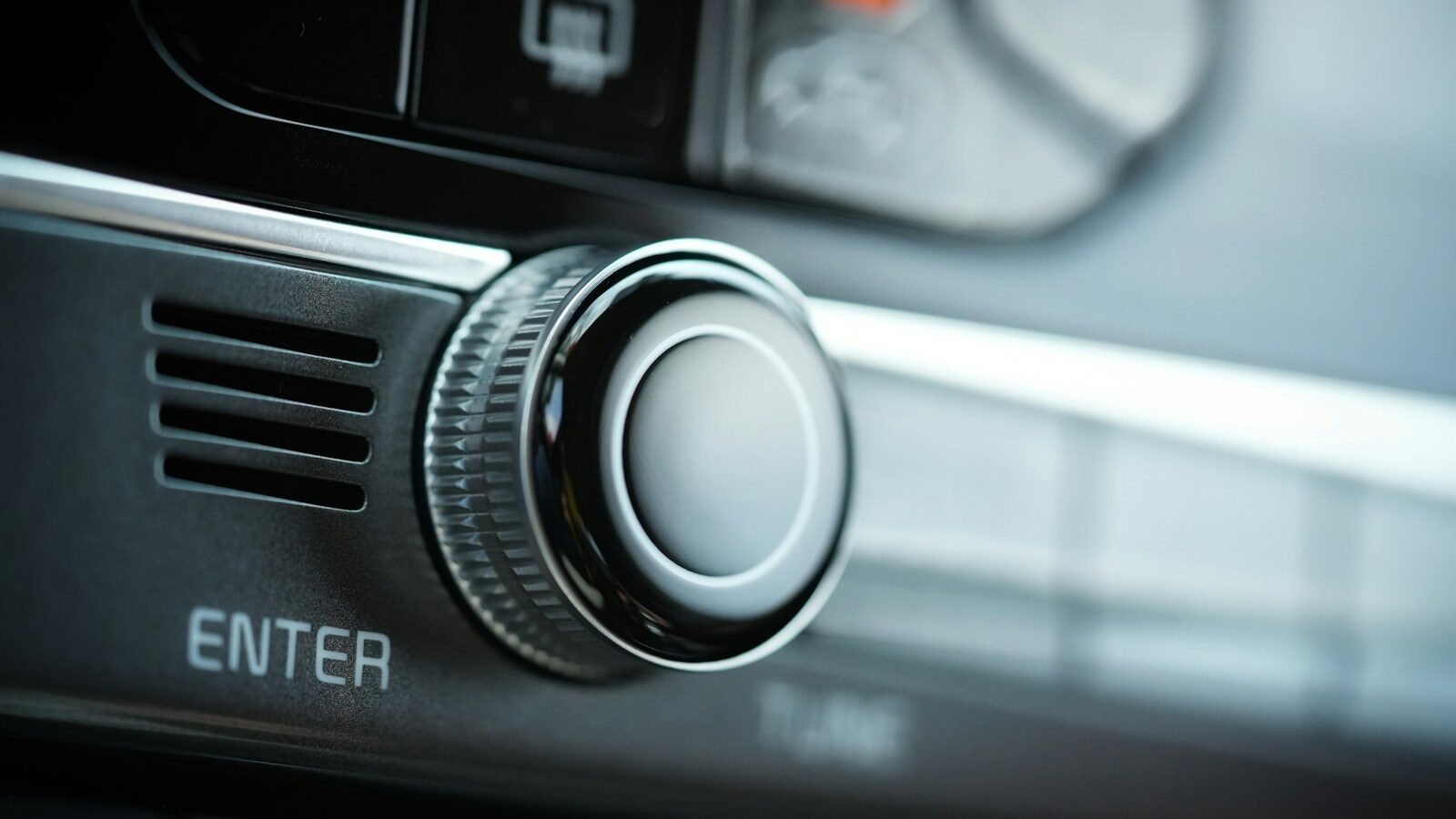
The regulatory backdrop makes this a design question, not a purchasing one. Euro NCAP’s 2026 protocols require indicators, wipers and washer, hazard lights, horn and the eCall button to be operated by a direct physical control rather than a touchscreen menu. Button clusters are moving back into the console, each needing a tactile dome switch underneath.
The press count is low, the exposure is not
A million-cycle rating answers a question most console buttons never ask. What ages a dome in a cabin is thermal relaxation of the stainless steel, creep in the spacer adhesive and tarnish on the contact surface. A button pressed twice a day for fifteen years accumulates roughly eleven thousand cycles, while sitting above 70 °C behind glass for hundreds of hours each summer. Weight the second number more heavily.
Feel and sound are part of the specification
In a quiet cabin the click is audible. Two domes with identical actuation force can sound different depending on geometry, material temper and how the cap couples to the crown. A tactile dome button that measures correctly on a bare force gauge can still sound hollow under a 0.5 mm overlay in a plastic housing. Record the click in the assembled stack, microphone and force curve together.
This button lives next to a cupholder
Coffee, condensation, hand cream, sunscreen and dust all reach the console first. Ingress protection belongs to the installation, not to the metal dome button: a good snap dome under a badly bonded overlay still lets liquid into the contact area. Test the assembled panel.
What should the force, travel and click ratio be validated against?
Against what the finger experiences through the overlay and housing, at the tolerance extremes of the stack, not the bare dome’s catalogue value. A dome specified at 180 g and 55 per cent click ratio behaves differently once a spacer, an overlay and a housing rib are added, and the extremes of that stack are where misfires appear.
Record the curve on a force-displacement tester with a synchronized electrical channel, so mechanical and electrical closure appear on one trace.
| Параметр | What to record | Why it matters in a console |
|---|---|---|
| Actuation force (F1) | Peak force at trip | Too low triggers on a resting hand, too high makes gloved users press twice |
| Return force (F2) | Force at release | Sets hysteresis and clean reset |
| Click ratio | (F1 minus F2) divided by F1 | Under roughly 40 per cent the click stops reading as deliberate |
| Путешествие | Crown displacement to contact | Has to leave overtravel for the cap |
| Free height | Unmounted dome height | Drives preload under the overlay |
| Footprint | 4 to 8.5 mm, or custom | Decides whether the cap sits over the crown centre |
Shanyo’s automotive range spans 100 g to 220 g actuation force, 40 to 65 per cent click ratio, 0.25 to 0.95 mm travel and 4 to 8.5 mm diameter, with formed shapes for asymmetric mounting (checked 26 October 2026).
Measure the curve, not one number
A single reading hides the shape of the drop after trip and the plateau before it. Two domes can both read 180 g and feel nothing alike. Run five pre-cycles, measure at the production actuator diameter, and keep curve files from first article, approval and post-life samples so drift is compared, not guessed.
Match dome geometry to the button footprint
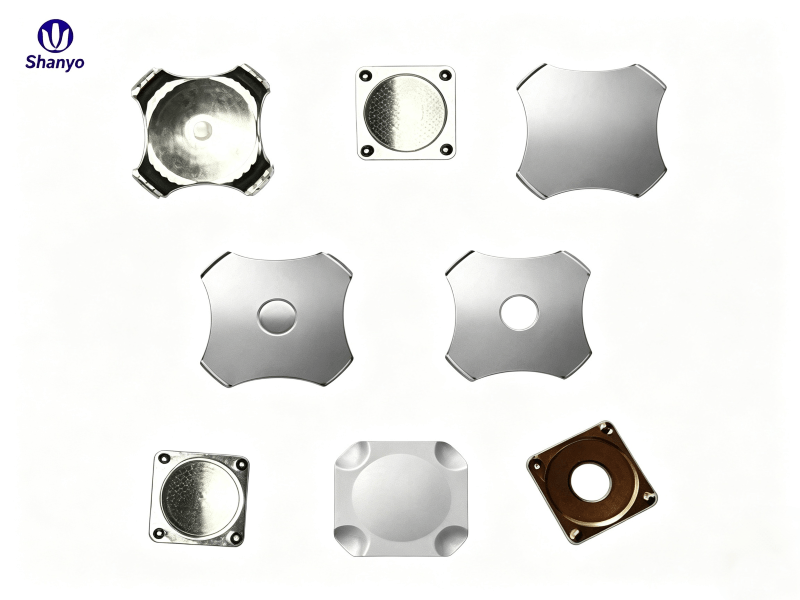
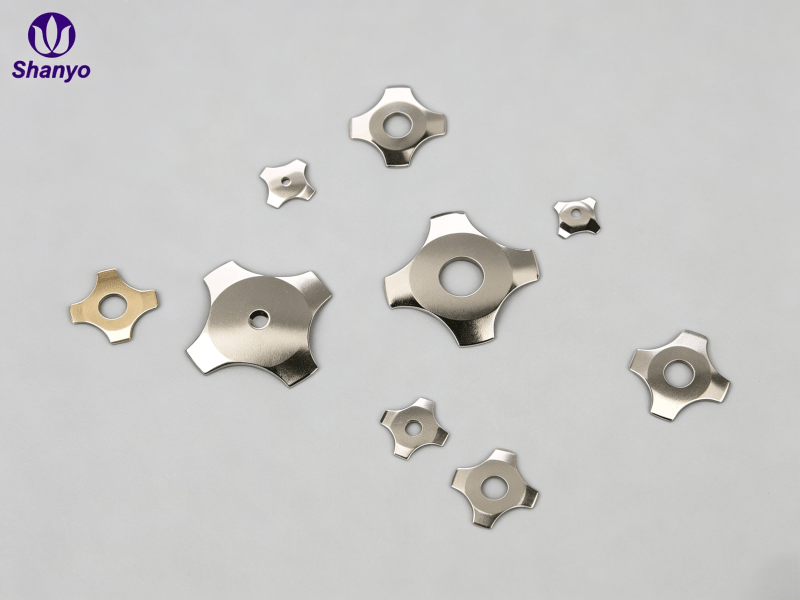
A round dome under a long oval cap gets actuated off-centre, loading one side of the металлический купол structure. Oval and four-leg geometries exist for that reason: four legs give four contact points and sit stably on an uneven pad, while the oval spreads travel along the long axis. Where the cap is asymmetric, ask for a formed shape rather than forcing a catalogue part into the pocket.
How do you validate the stack-up around the dome?
By building the tolerance loop from PCB pad to cap and testing the worst-case combinations, not the nominal one. The dome is the only element designed to move, so every tolerance above and below it either adds to the force the finger applies or subtracts travel until the switch stops firing.
| Stack element | What drifts | Check |
|---|---|---|
| PCB pad | Copper thickness, solder mask step | Pad coplanarity across the panel |
| Spacer or carrier | Adhesive thickness, die-cut registration | Clearance around the dome rim |
| Overlay | Thickness, emboss height, stiffness | Force re-measured with the production overlay |
| Housing rib or hard stop | Moulding tolerance, thermal growth | Overtravel under 80 per cent of dome travel |
Overtravel, venting and pad geometry
Validate both stack extremes: at minimum gap the overlay preloads the dome and the click collapses, while at maximum gap the cap runs out of travel before the crown reaches the pad. Neither shows up in an electrical test. Limit overtravel to about 80 per cent of dome travel, or the crown flattens past its elastic range and loses return force. Give trapped air a path, because a sealed overlay over a sealed pocket slows actuation and distorts the curve. A self-wiping contact geometry keeps resistance stable, and deburred edges stop the part scratching the pad during placement.

What electrical checks belong in the plan?
Contact resistance at the module’s real signal level, measured four-wire before and after conditioning; bounce time measured against the firmware debounce window; and a plating system chosen for cabin atmosphere rather than the lowest initial resistance.
Contact resistance at the module’s real signal level
Console switches switch signals, not power. In a dry circuit there is not enough voltage or current to break a surface film at closure, so a film that a power contact would wipe away becomes a missed press. Measure four-wire at the specified test current following ASTM B667 or EIA-364-23, after five stabilising cycles. A gold-plated dome on an ENIG pad typically starts between 10 and 50 milliohms; nickel on HASL or OSP reads higher. Shanyo specifies automotive contact resistance below 1 ohm at component level (checked 26 October 2026).
Contact bounce and the debounce budget
Bounce on a standard tactile snap switch usually runs 1 to 5 milliseconds and grows as surfaces wear. Debounce at 5 ms, and a worn dome at 6 ms produces double entries blamed on software. Set the window to at least twice the maximum measured bounce, and re-measure at end of life.
Plating against cabin sulfur and humidity
Gold resists oxidation and tarnish and suits low-current contacts, typically 0.025 to 0.2 micrometres over a 1.25 to 3 micrometre nickel barrier. Silver conducts better but forms sulfide films in a cabin, which matters for a contact unused for weeks. Tin is cheapest and carries whisker and fretting risk without a barrier. Selective plating, gold on the crown and tin on the solderable feet, is a legitimate answer, not a compromise.
How should life and environmental testing be sequenced?
Cycle first with an actuator that matches the production button, condition the survivors thermally and in humidity, then measure resistance and force again on the same parts. A dome can keep closing the circuit while losing the click, and a test that stops at continuity will pass a part customers call mushy.
| Test | Reference | What a pass looks like |
|---|---|---|
| Life cycling | Production actuator, centre strike | Force drift within plus or minus 20 per cent |
| Thermal cycling | ISO 16750-4, passenger compartment | No cracking, no loss of return |
| Damp heat | ISO 16750-4 | Insulation held, no adhesive lift |
| Vibration and shock | ISO 16750-3 | No intermittent contact, no dome migration |
| Chemical exposure | ISO 16750-5 | No swelling, hazing or resistance rise |
Cycles plus force degradation
A million cycles is a reasonable target for an automotive metal dome, and Shanyo rates its automotive parts at 1,000,000 or more press cycles across minus 40 to plus 85 °C (checked 26 October 2026). What matters is force at the end of the run, measured at intervals, because the failure customers notice is a softer click, not an open circuit.
Thermal, humidity and vibration
The ISO 16750 series sets environmental conditions by mounting location. Part 3 covers mechanical loads and part 4 covers climatic loads, and both separate passenger compartment severity from engine bay severity. Console switches sit in the milder category, which argues for testing to the right level: an engine-bay profile applied to a console part says little about its real failure modes.
Chemical exposure from a cabin, not an engine bay
ISO 16750-5 covers chemical loads, and the list for a console part reads like a household inventory: cleaning agents, hand cream, sunscreen, soft drinks. Test the assembled overlay, because the graphic layer and its adhesive are more vulnerable than the metal.
What production evidence should you see before tooling release?
A certified quality system with a part-specific approval file behind it: IATF 16949 certification, an approved process FMEA and control plan, capability data on force and free height, and a retained master sample that can settle arguments later.
The quality system behind the part
IATF 16949 is the baseline for automotive supply and usually the first question a Tier 1 asks. Shanyo holds IATF 16949 certification along with ISO 14001 and ISO 45001, and has stamped material as thin as 0.02 mm, which matters when dome height tolerances tighten.
PPAP, capability and the control plan
The AIAG Production Part Approval Process defines 18 elements, ending with the Part Submission Warrant that signs the package off. For a dome, read the dimensional results, the material and performance data, the initial process study on actuation force and free height, and the control plan for those characteristics. A catalogue and a certificate do not demonstrate a process.
Audit evidence, not slideware
Ask what an actual customer audit found. When a Tier 1 such as Valeo ran a three-day on-site pre-audit covering cleanliness, tooling, stamping, testing and electroplating, what was examined and what was fixed afterwards said more than any logo. A supplier pre-audit case study documents that sequence from first request to feedback.
ЧАСТО ЗАДАВАЕМЫЕ ВОПРОСЫ
How is a center console dome validated for automotive programs?
It is validated as part of the switch assembly, not as a standalone part. The approval package covers the dome, the spacer or carrier and the electrical results together, and the dimensional and capability studies use the same characteristic list as the control plan.
Why does a button feel softer after a year in service?
Thermal relaxation lets the stainless steel lose part of its stored force, and adhesive creep in the spacer reduces preload under the overlay. Both shift the force curve downward without breaking the circuit, which is why force drift needs to be a pass or fail line in the life test.
Can a dome be reflow-soldered onto the console PCB?
Yes, when the part is designed for it. Solderable snap domes ship on tape and reel with plating selected for reflow, and the dome body is engineered to survive the thermal profile without losing force. Insist on post-reflow force and resistance measured on parts from the production line, not a lab sample.