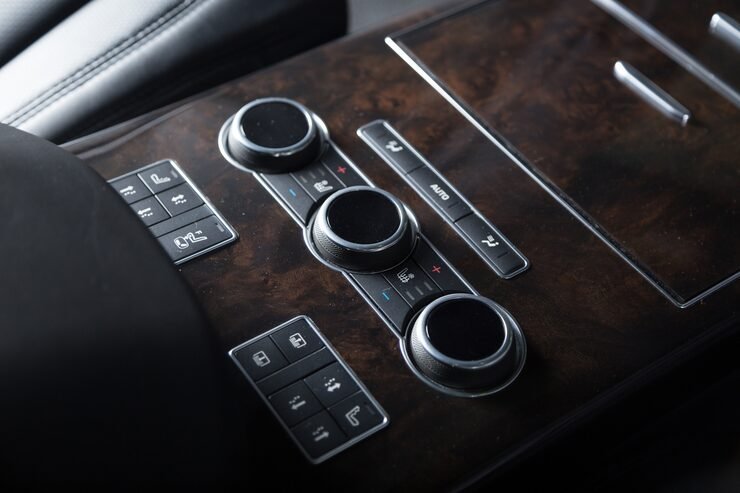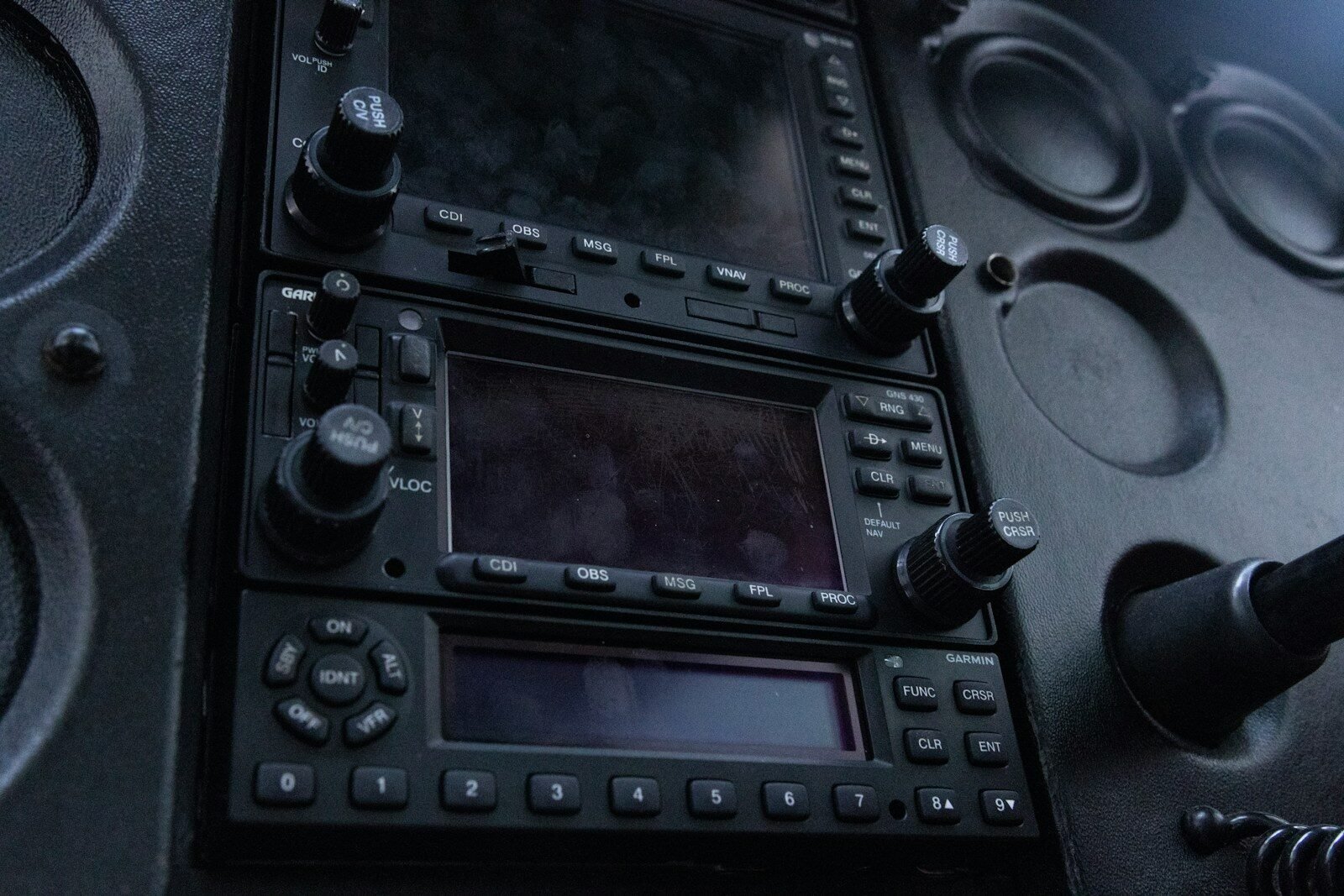
Touchscreens took over car interiors for a decade, then the industry started putting buttons back. Safety rating programs now reward cabins where essential functions work by feel rather than by sight. Underneath nearly every one of those buttons sits a stamped steel disc that snaps when pressed. It appears across so many automotive applications that listing where it does not fit is easier than listing where it does.
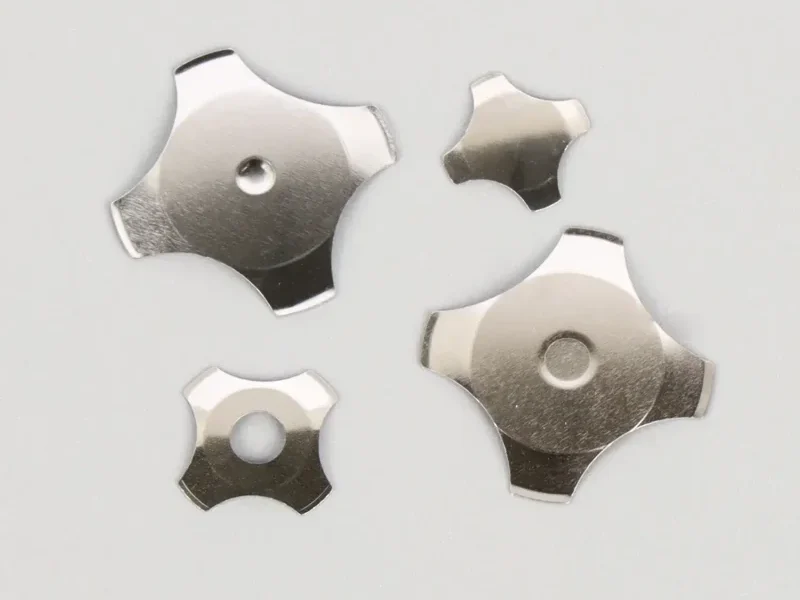
A metal dome is the moving contact inside a push button: a shallow, pre-formed stainless steel disc that rests on the outer ring of a circuit pad, buckles inward with a distinct snap when pressed, touches the center contact to close the circuit, and springs back when released. In automotive electronics it is used for steering wheel controls, center console keys, climate panels, door and seat modules, key fobs, and any button that has to work by touch without the driver looking down.
This article maps where metal domes are used in a vehicle and how the specification changes once the cabin environment is considered.
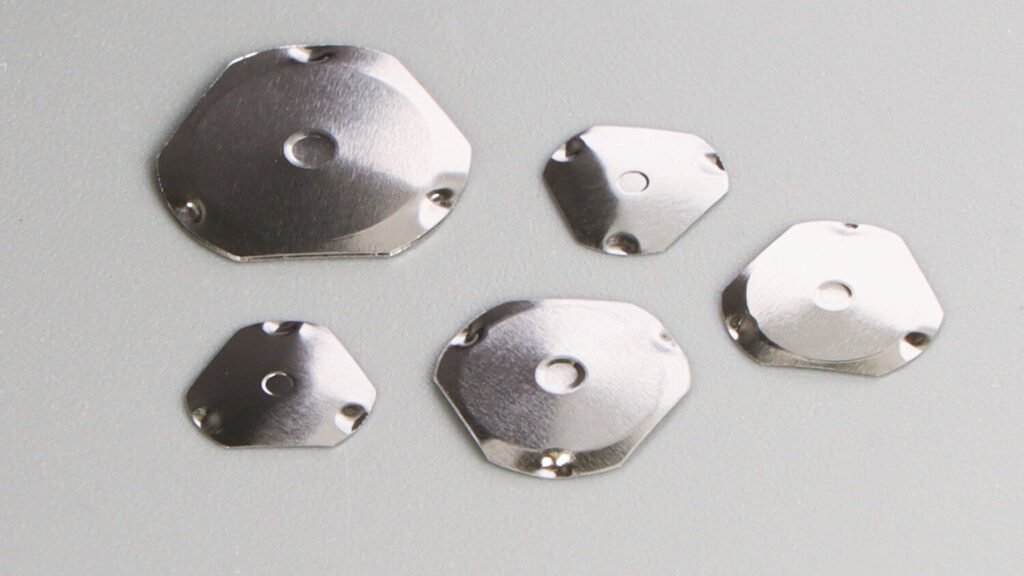
Where a metal dome sits inside a vehicle control panel
A metal dome sits directly above the circuit contact and directly below the keycap. It is the only part in the stack that both moves and carries current, which is why its force, shape, and plating decide how the finished button feels and how long it lasts.
Under the plastic is a stack of parts, and each one changes the force the driver feels. A stiff overlay adds preload. A flexible circuit absorbs travel. An off-center plunger tilts the dome so it snaps unevenly. Specify a dome by diameter and force alone, and the assembled button often feels softer than the drawing said.
How the dome closes a circuit
The perimeter rests on an outer contact ring. Press it, and the disc inverts, its center touches the pad, and current flows. Release it, and the steel returns to shape. Because the metal is both spring and moving contact, nothing else has to move. The snap takes milliseconds and gives the driver a click plus a resistance change under the finger.
The layers built around a dome
From the driver’s finger down to the board:
- Molded keycap with a printed legend
- Centered plunger or elastomer pad
- Graphic overlay or spacer
- Metallkuppel
- Adhesive carrier holding position
- PCB or FPC contact pattern
- Rigid support and a vent path
Every layer interacts. A blocked vent traps air and slows the return, and a plunger that is too tall softens the click. Dome selection is reviewed with the keycap, actuator, and pad design, not on its own.
The main automotive electronics uses of metal domes
In automotive electronics, metal domes are used wherever someone needs a short, repeatable press with a clear response: steering wheel spokes, center console and climate panels, door and seat modules, key fobs, safety and driver assistance switches, and the newer control surfaces on electric vehicles.
The list is long because the reason repeats. A dome gives a defined snap in a package under a millimeter thick, and it keeps that snap for hundreds of thousands of presses.
Steering wheel and spoke controls
Space on a wheel is tight, and every control has to be distinguishable by touch. Domes fit the available depth, and force can be tuned key by key.
Center console, climate, and infotainment panels
These panels pack many keys into one assembly, often centimeters apart. Hold the dome size and force consistent across the panel, and the keys feel like one object.
Door, seat, and mirror control modules
Window lifts, mirrors, seat memory, and locks share a module exposed to sunlight, humidity, temperature cycling, and road vibration. Stainless steel and a single moving part are why it copes.
Key fobs and keyless entry
A fob is pressed thousands of times, usually in a pocket with keys and coins. Short travel suits a thin enclosure, and force can be raised to prevent accidental triggers.
Safety and driver assistance switches
Hazard lights, parking assistance, lane keeping, and adaptive cruise are pressed rarely and in a hurry. The driver needs to know the command registered without checking a screen.
EV and electrified drivetrain interfaces
Drive mode, regenerative braking strength, and charging controls are new to the dashboard. Many sit on physical keys because a quiet cabin makes the click noticeable.
| Vehicle zone | Typical functions | Why a dome fits |
|---|---|---|
| Steering wheel | Media, cruise, voice, phone | Thin profile, distinct force per key |
| Center console | Climate, audio, drive mode | Konsistentes Gefühl über viele Tasten hinweg |
| Door and seat modules | Windows, mirrors, memory, locks | Stable under vibration and UV |
| Key fob | Lock, unlock, trunk, panic | Short travel, resists accidental press |
| Safety and driver assistance | Hazard, parking assist, lane keeping | Confirmation without a screen |
| EV interfaces | Drive mode, regen, charging | Frequent use, quiet cabin |
Why automotive designers pick metal domes over other switch types
Three reasons decide it: tactile feedback the driver can trust without looking, stable performance across the temperature and vibration range inside a car, and an actuation life that outlasts the vehicle.
Tactile feedback that keeps the driver’s eyes on the road
The U.S. National Highway Traffic Safety Administration recommends guidelines for driver distraction that in-vehicle tasks be designed so individual glances away from the road stay at two seconds or less, with cumulative time under twelve seconds. Those criteria appear in NHTSA’s visual-manual driver distraction guidelines. A key with a snap response helps a driver stay inside that budget, because it can be found by position and confirmed by feel. A touchscreen asks for a look, a search for the icon, and a check that the press registered.
Performance across temperature, humidity, and vibration
A cabin swings from below freezing on a winter morning to well above 60°C on a dashboard in the summer sun, and a control module also sees condensation, UV, and road vibration. Stainless steel does not soften or creep at those temperatures, so the force curve stays close to specification. Sealed variants keep moisture off the contact area, and a vented carrier lets trapped air escape.
Actuation life against vehicle lifespan
Domes are commonly built for several hundred thousand to over a million actuations. Against a vehicle driven daily for ten to fifteen years, that margin keeps a button feeling the same in year twelve as in year one.
| Eigenschaft | Kuppelschalter aus Metall | Silicone rubber keypad | Capacitive touch |
|---|---|---|---|
| Tactile confirmation | Sharp, mechanical | Softer, gradual | None, or electronic simulation |
| The driver has to look. | Nein | Rarely | Usually yes. |
| Contact stability | High with matched plating | Depends on carbon pill wear | No mechanical contact |
| Behavior when powered off | Works | Works | Dead |
How metal dome specifications are matched to automotive requirements
Specification starts with the button feel the program wants, then works backward through the stack to values that can be measured on a drawing: trip force, return force, travel, tactile ratio, force tolerance, shape, plating, and the pad finish it sits on.
Words like “crisp” or “premium” are not acceptance criteria. They have to become numbers a supplier can hold across a production run.
Actuation force and tactile ratio
Trip force sets how hard the key is to press. Tactile ratio describes the contrast between peak force and the force after the snap, and a higher ratio reads as a sharper click. Measure both with the actuator the finished button will use, not a bare dome on a flat plate.
Shape and footprint
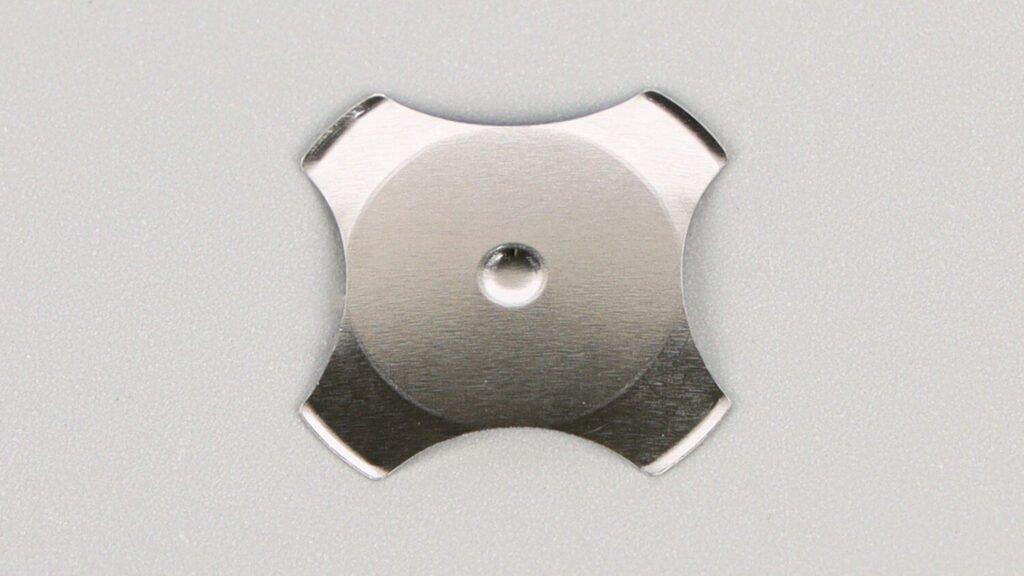
Four leg domes have defined support points and open space between the legs, which helps when air has to move. Round domes suit circular legends. Triangle and oblong shapes fit footprints where a circle will not go, but each needs its own contact pattern, and they are not interchangeable on one pad.
Plating and contact stability
The pad finish matters as much as the dome. Gold plating with a matching pad keeps contact resistance stable over hundreds of thousands of cycles and through humidity swings. For cost-sensitive keys, a nickel-plated dome with a suitable pad can be enough.
Sealing and venting
Sealing keeps dust, spills, and condensation out of the contact area. Venting lets air escape as the dome collapses, because a trapped pocket slows the return and flattens the click.
Loose domes versus dome arrays
On one key, a loose dome is the simplest. On a multi-key panel, placement and retention become the real cost. Large keypads are usually ordered as a custom tactile metal dome array, which holds many domes at fixed coordinates under one die-cut carrier so the panel registers in a single assembly step.
How metal domes are adapting to new vehicle architectures
Two changes are shaping dome design now: electrification, which makes the cabin quieter and the click more noticeable, and the return of physical controls to interfaces that had been handed to screens.
Backlit carriers and light guide films let a dome sit under an illuminated legend without losing travel, and some designs pair the mechanical snap with a separate actuator that adds a second confirmation. A dome also works when the system is powered down, so a frozen display does not take the function with it.
FAQ
Do metal dome switches work in cold and hot weather?
Yes. Stainless steel keeps its snap from below freezing to the heat of a sun-soaked dashboard. Force shifts slightly with temperature, so a development program verifies the button at both ends of the range.
What is the difference between a metal dome and a dome array?
A dome is one disc. An array is many domes held at fixed positions under a die-cut carrier, with an adhesive layer that keeps alignment during assembly. Multi-key panels therefore use arrays rather than loose domes.
Can metal domes be backlit?
Yes. Light from an LED under the board passes through or around the dome area and out through a light guide film or a translucent legend. Backlighting adds layers, so the vent path and travel should be rechecked once it is specified.